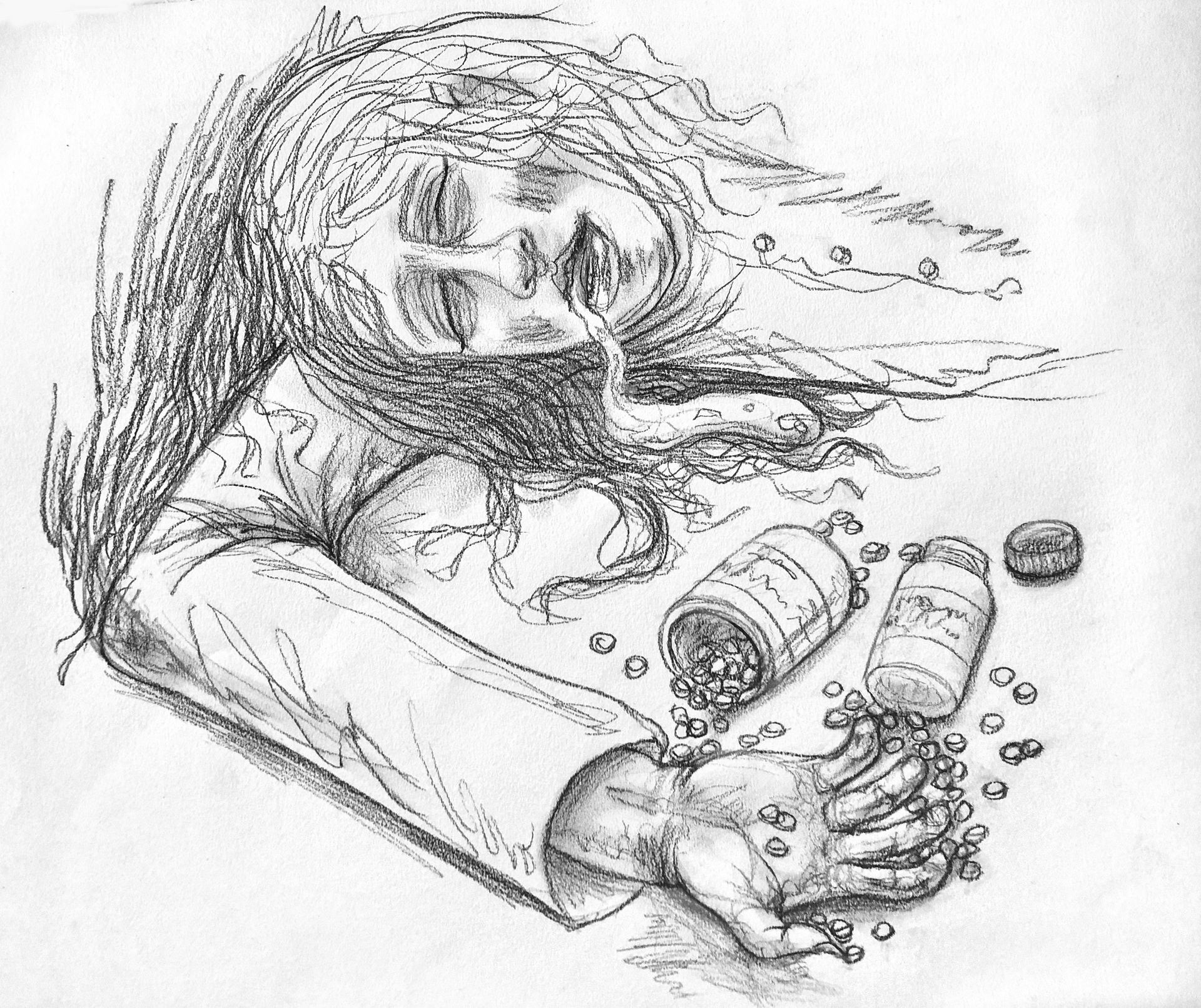
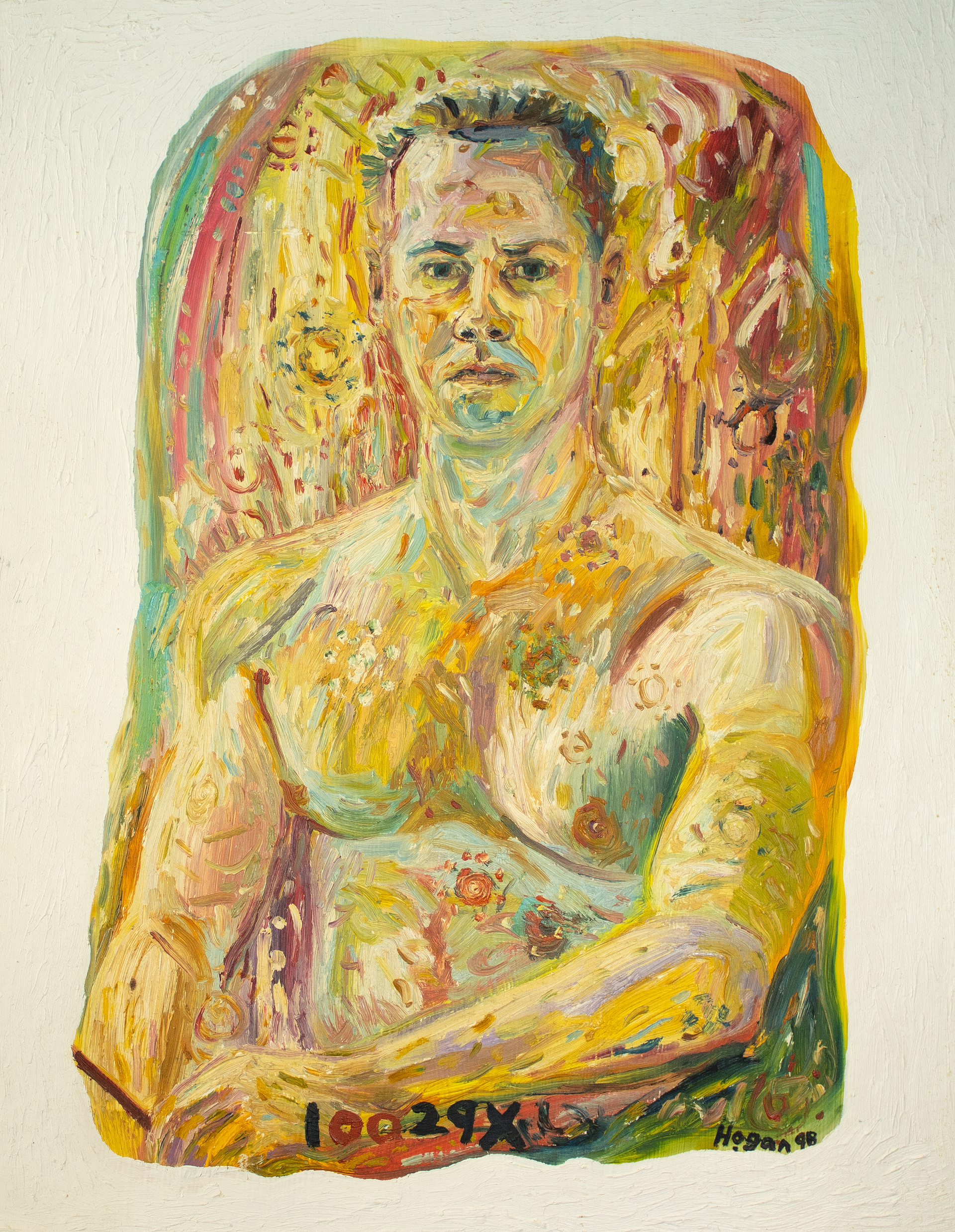
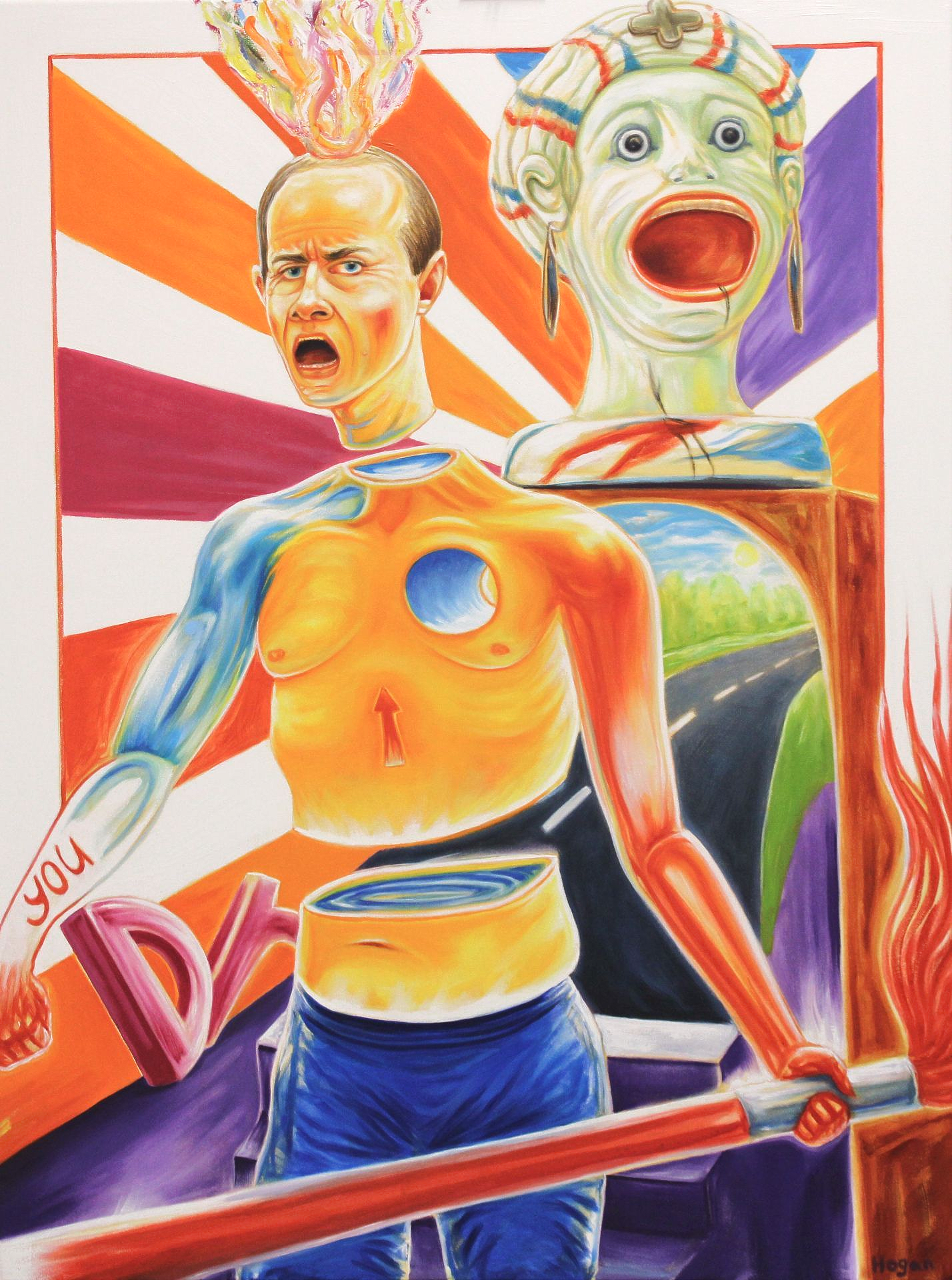
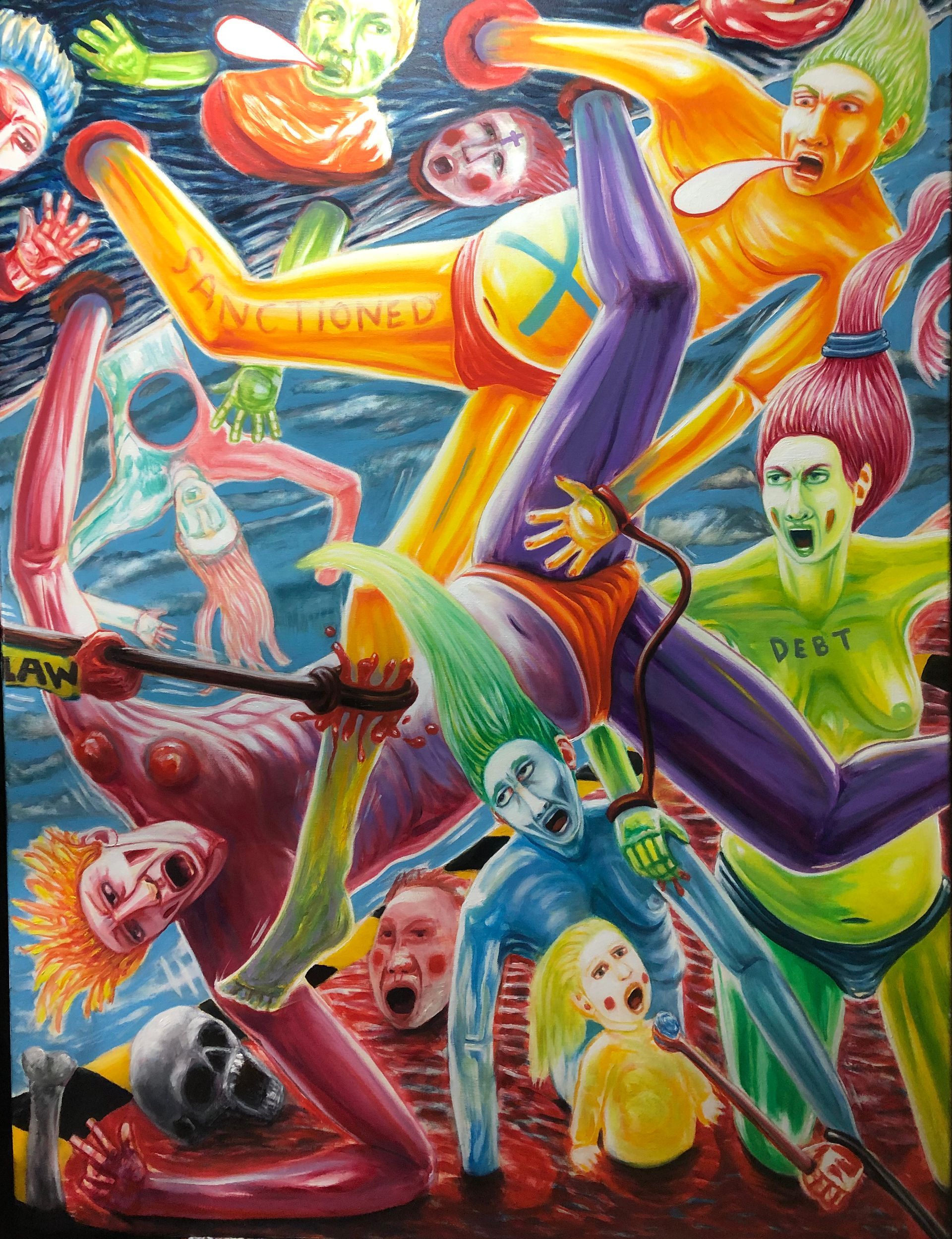
Q1. Could you please share some insights into your personal and artistic journey? What specific experiences and motivations have shaped you into the individual you are today?
I am now in my early 50’s. I began drawing and painting from a very young age, I can remember drawing before primary school. All my life I have had a compulsion to create. Life has created barriers to this creativity, however, I persisted as it was a part of me, and I had to do it to fulfill creative urges. I believe an artist is born not made. Genetically predisposed. Many people dislike this view, and it can be met with great hostility. Indeed, contemporary art through the critics such as Clement Greenberg have discounted the notion of the unique artist, dispelling concepts of innate talent, as elitist, and arrogence on the part of the artist who must therefore believe they are special and unique. I find this idea personally affronting. I am what I am. I have a natural ability, I was made this way.
I didnt have the best of starts in life, not unlike many people. I came from a working class family, we had the basics of existence. We lived on council estates, we moved a lot when I was a boy so never gained friends and always felt insecure. I left the family home when I was 15 due to an abusive step dad, and a divorce that precipitated my mother leaving. I was homeless for 18 months. I had to learn how to survive very quickly. I was variousely employed, mostly farms, building sites, factories, working class, mundane jobs. I also had periods of unemployment. I drew and painted constantly throughout this time, I travelled through many bedsits. I alwys maintained my artwork in various forms. When I was 21 I entered university on the strength of my artwork that I produced at the interview. University changed my life, it was a culture shock after being on building sites, very civilised. I was quite rough around the edges. My BA was in Graphic Design/illustration. My MA (which I accomplished over ten years later, was in Illustration. I managed to find an illustration agent when I completed my BA. Over a two year period I completed many briefs for national and international clients. I met my future wife at university. The in laws, didn't believe the creative industries were financially sustainable for their daughters future happiness. They encouraged me to retrain. I subsequently embarked on a psychiatric nursing degree (4 years training) When completed I was employed by the private health care system, I worked in the community for various trusts and then into the NHS. I was employed in a forensic high secure hospital for the criminally insane for 5 years. It changed me forever. As a homeless person I had experienced trauma, however, After reading hundreds of patient histories, It made me realise just how widespread the personal and societal dysfunctionality is. Long story short, I lost everything, my wife, house, and employment as a qualified nurse. I ended up back in a bedsit, with seemingly no hope and no future. It took a long while building myself back. One of the positive things about learning life early is that your ‘fight’ remains with you. I am a very determined person, dogmatically so, I posess a very strong personal drive. To be able to teach I required a PHD, and so here I am. I always avoided the fine art education route myself. All I could see was conceptual art. Very little painting and mostly abstracted or deconstructed to varying degrees. I was always a figurative painter, as far back as I can remember, all the artists that influenced me, and that I admired, where figurative painters. Satire has always been part of my life, I just didn't know or understand the concept until I was older. I understand now, that a satirical catalyist describes my life experience. I also know that satire is an extremely powerful tool. I added painting as vehicle, and autoethnography as driver.
Q2. How do you incorporate satire into your paintings to convey powerful messages to your audience? Could you also shed light on your creative process when bringing a finished artwork to life?
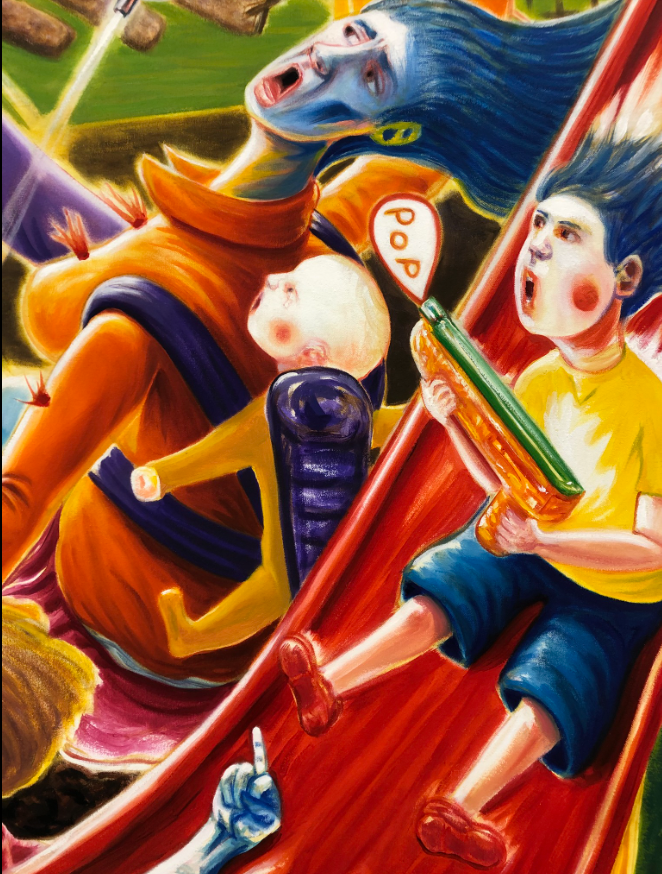
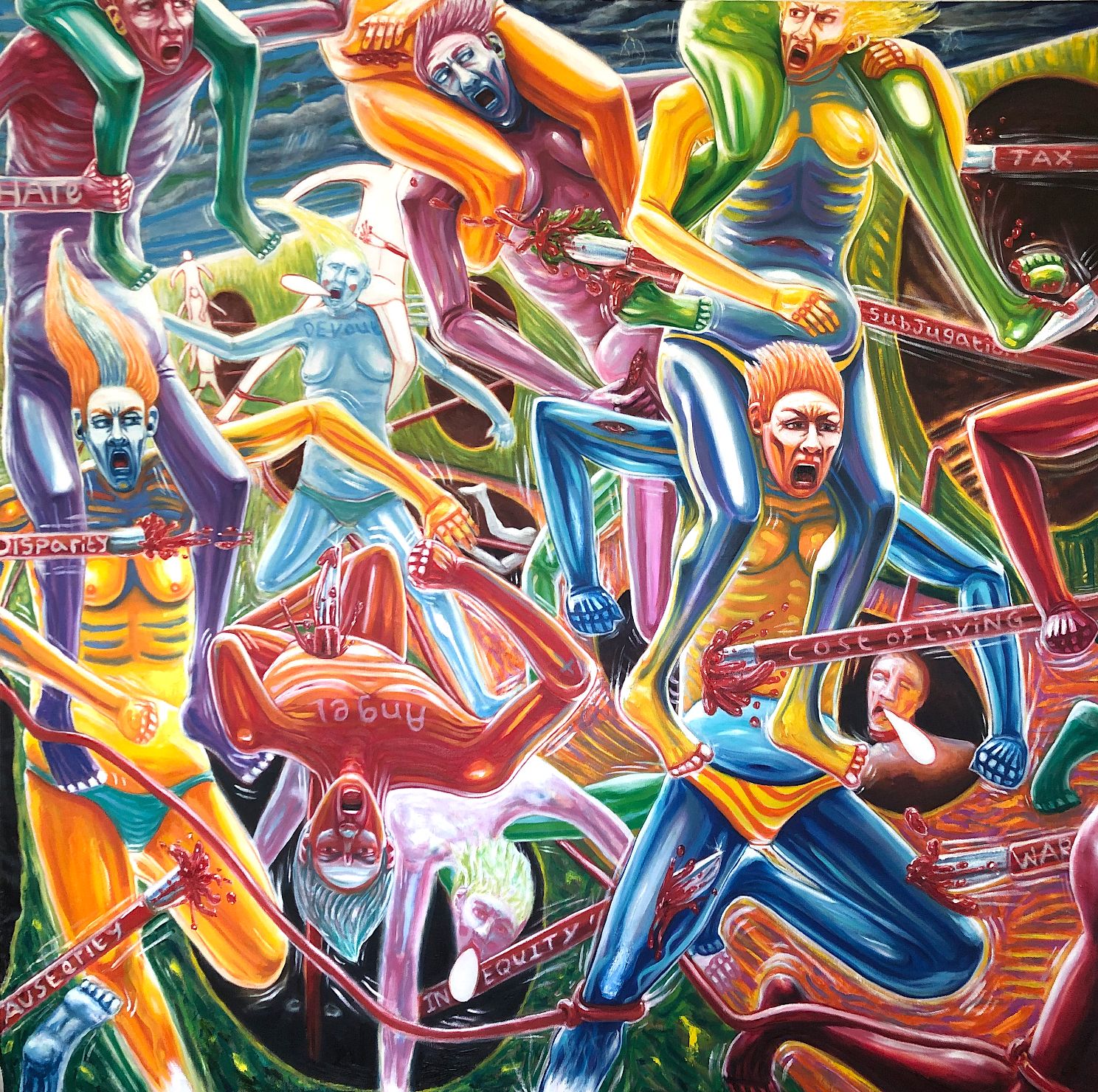
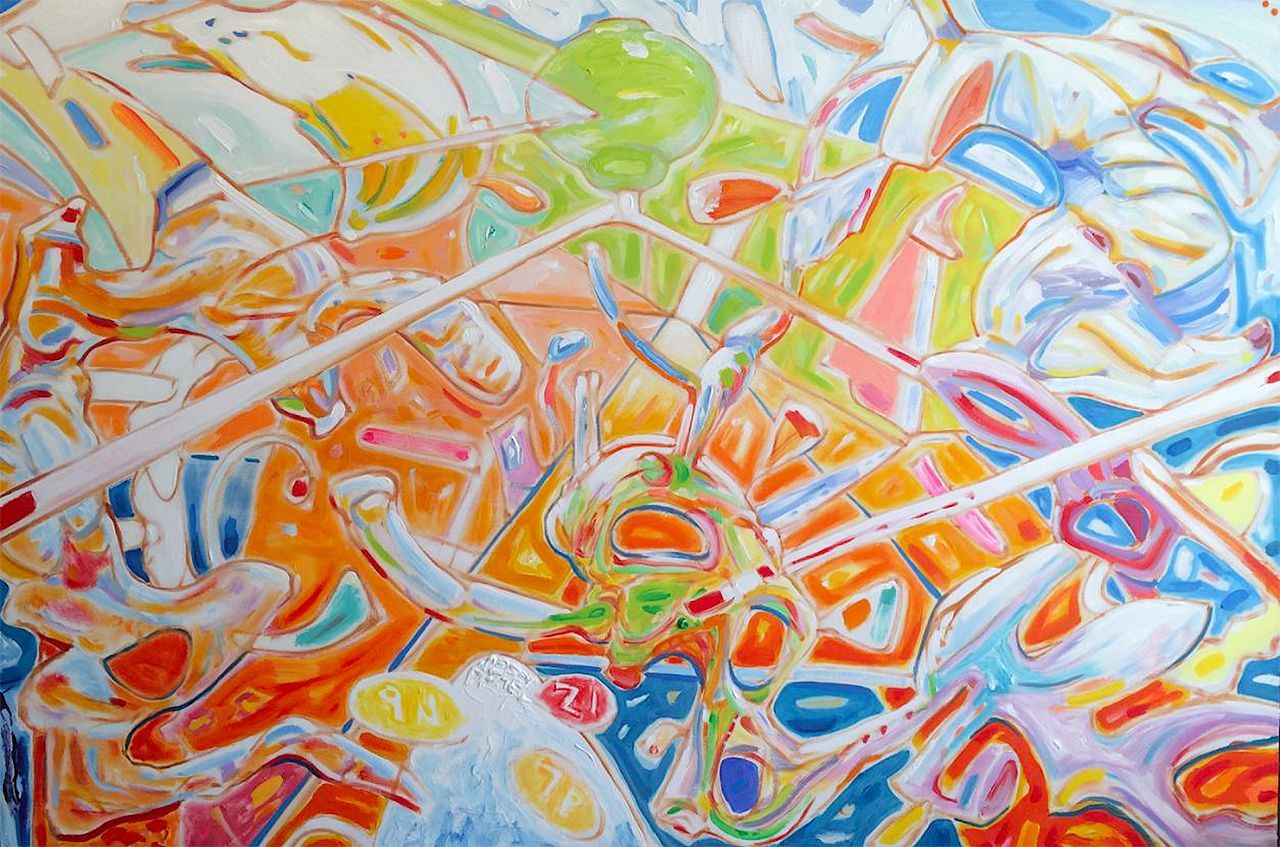
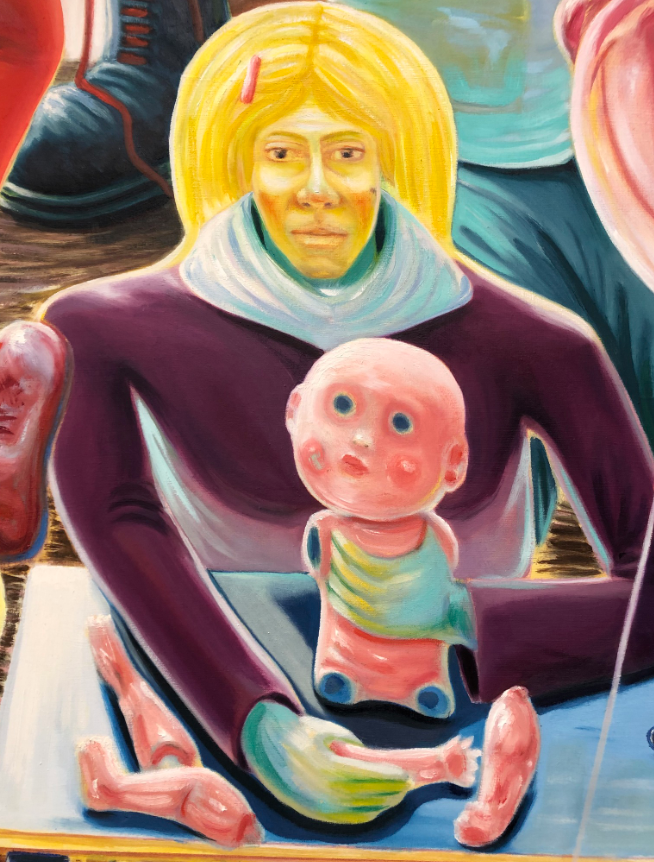
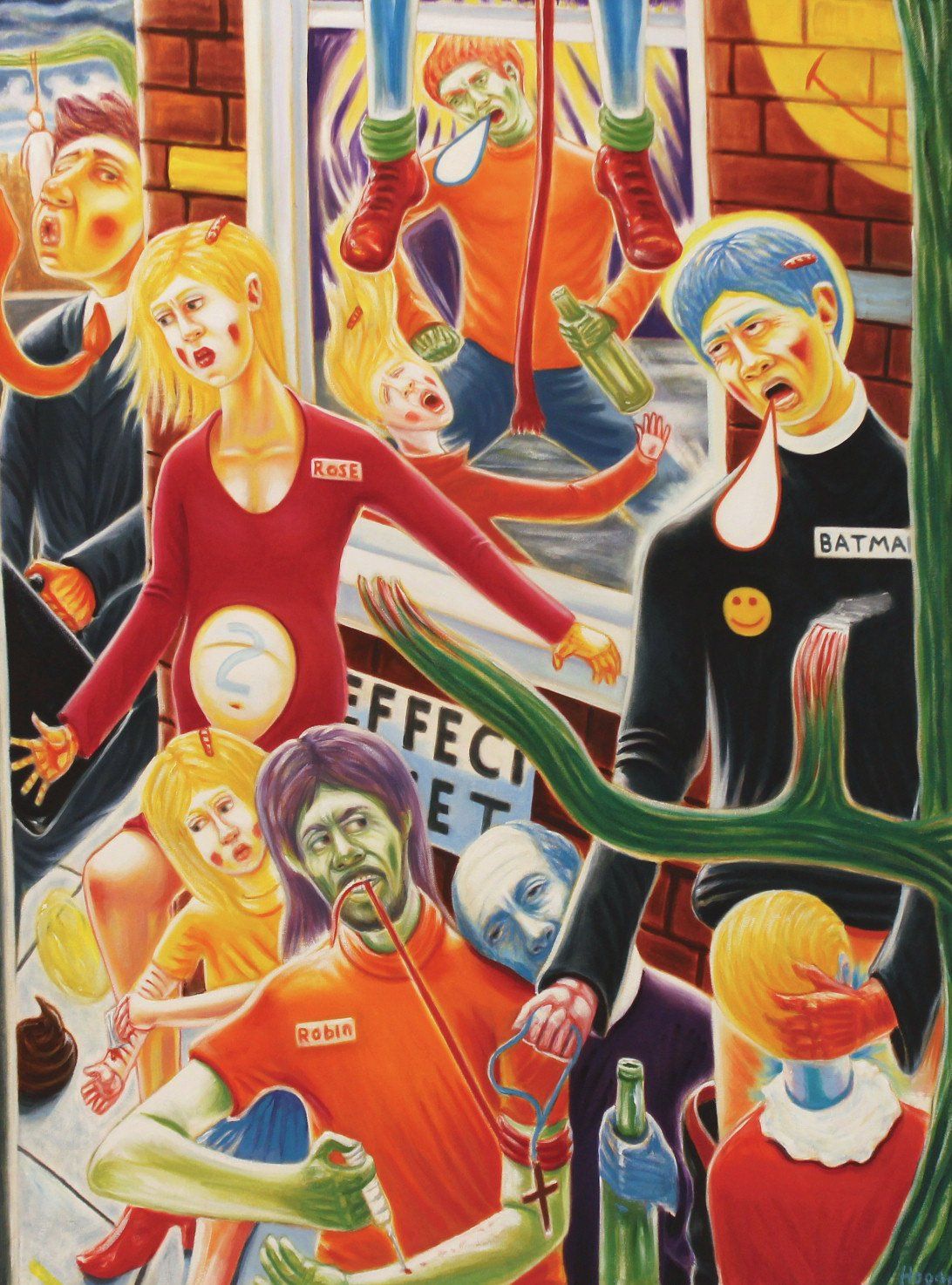
My personal and professional ethos encorperates egalitarian principles. Everyone is equal, Art (painting) is for everyone, not just an elite few. In this respect, the aim of my work is accessiblity, I wish my work to be easily read. Satire’s codes offer a vehicle for relationality through universality. Codes such as, parody, analogy, metaphor, and subversion, and universally recognised signs, icons, and graphics, can be utilised to inject a powerful means of communication. I also use the universality of humour. I do this in a number of ways, through comical characterisation, a focus on primary colours to accentuate the ‘cartoon’ aesthetic, and I utilise design principles such as space, perspective, perceived motion, and depth to create a satirical narrative. I view my work not unlike a cartoon animation film still, an episode captured in time. I do have video content on you tube which describes my process it can be viewed here: https://www.youtube.com/channel/UCmGXwgqNRfzWuvqQ7lGzvVQ
Q3.In your statement, you mentioned that your art goes "above and beyond present contemporary multimedia and modern art’s theoretical ideation." Can you deconstruct these ideas for us?
Satire tends to be circumscribed by a limited understanding of media in which it can be realised. It appears that a majority of people assume that Satire only exists through the doctrines of political cartooning and amateur memes. However, the common experience of painting has affect through emotive response. The aesthetic judgement is that whose determining ground lies in a sensation that is immediately connected with a feeling of pleasure and displeasure. I understand that painting is a unique vehicle. A painting's uniqueness underlies its status as a precious object. The singularity, preciousness, and longevity of the painted picture continue to have a latent resonance in painting’s contemporary status, painting is a high art, a universal art, a liberal art, an art through which we can achieve transcendence and catharsis. Painting is a great unbroken tradition that encompasses the entire known history of man. The expressive warmth and subjectivity of painting, opposed to the cold functionality of the digital image, which serves primarily as a vehicle of information. In contrast to the rapidity, ubiquity, and ease of digital reproduction, the labour of painting and the comparative slowness of execution gives it a singularity that lifts it out of the unending flow of media images. Satire can continue to illicit credence through the specificity of paintings vitalistic vernaculars.
Painting has persisted despite innumerable efforts to negate it. Most explicitly, from the post-war period onward, painting has been fractured, deconstructed, and reconstructed again. Illustrated by the retreat from medium specificity, in the 1970’s, a move largely made in opposition to the hegemonic force of Greenbergian formalism and the expanded field. Painting was killed by revolutions, it was killed by commodities; it was killed by flatness, and it was killed by sheer boredom, but repeatedly it was resurrected only to die another day. This is painting’s modern tragedy: a modern form of history painting. Painting is based upon an intrinsic aesthetic, a pleasurable commodity, Painting operates in the realm of sensual and affective qualities. However, Modernism is opposed to the notion of painting as a pleasurable commodity. Among the traditional distinctions shed by art after Modernism were the specifications of genres and media. This condition of ‘post-modern art’ has acquired titles such as the ‘dematerialized art object’ (Lucy Lippard); ‘Intermedia’ (Dick Higgins) and the ‘post-medium condition’ (Rosalind Krauss). The loss of this distinction between art and ‘life’ meant a corresponding loss of certainty about what the rightful object of aesthetics actually was. (Best, S. Halsall, F. J, O’Connor. 2006) Postmodernism neither brackets nor suspends the allegory referent but works instead to problematize its reference. I would argue that the heterogeneity of art necessitates a return to the importance of auto ethnographic practice. Artists may be aware of the codices of visual aesthetics and may utilise this knowledge to apportion meaning through allegorical narratives. Allegorical narratives will remain a failure to read unless an understanding of the universality of visual language is employed to elicit accessibility, readability and moral empathy. My project frames painting practice as fitting in relation to our erratic times as it intrinsically holds within it, abundant possibilities for examining feelings of change and variance, expressively, materially, and idiomatically. Painting has a history of re-invention, and, so, in support of this, I contend that rectification in painting is continuously revealed culturally, materially, and through the vehicle of painting's vernaculars. Painting is both reflective and reactive. Graw postulates; ‘Painting is its context’ painting has sustained itself by internalising socially constructed values.’ However, Joselit asserts that; ‘painting is ‘beside itself’, transitivity is a form of translation; when it enters networks, paintings are submitted to infinite dislocations, fragmentations and degradations, as Kippenberger suggested, these framing conditions cannot be quarantined, painting is beside itself.’ (Joselit 2013). Owens argument manifests mediation, particularly regarding allegory; ‘Painting is palimpsestuous, in having been reused or altered while still retaining traces of its earlier form; ‘A multilayered record, the withdrawal of the modernist arts from allegory may thus be one factor in their ever-accelerating loss’ (Owens. 1980)
How do you perceive the current political and social atmosphere, and what are your thoughts on its impact? Furthermore, where do you believe art stands amidst these global changes and modifications?
The world is in Perma crisis. Defined as an extended period of instability and insecurity, and illustrated through dysfunctional World politics, multi-societal inequalities, and injustices. A constant state of uncertainty and worry, through the upheaval caused by high energy costs and a universal cost of living crisis, world poverty, the covid pandemic, climate change, world societal displacement, heightened migration, and a devastating war in Ukraine showing no sign of de-escalation. Bad news is seemingly everywhere, this is the milieu in which satire exists.
I position my work within the alter modern spectrum. Nicholas Bourriaud augmented the term Altermodernism and curated The Tate Britain Tate Triennial in 2009. Presented a collective discussion around the premise that postmodernism was coming to an end, and that we are experiencing the emergence of a global altermodernity. Bourriaud stipulated that the new universality of world cultures marked a world culture shift as opposed to a Colonial west centric criticism attributed to the auspices of both modernism, and postmodernism. Alter modernism offers a multicultural universality defined by creolisation and polyglot expansion. “Contemporary culture can no longer be seen as a single totality, but as an interrelated network, described as an archipelago. Post modernism is dead. A new modernity is emerging, reconfigured to an age of globalisation, understood in its economic, political and cultural aspects: an altermodern culture.” (Bourriaud, N.1998) The Tate biennial exhibition was curated to involve the artists that Bourriaud recognised as fulfilling the new Altermodern agenda. “The art is characterised by artists cross border, cross cultural negotiation; a new real and virtual mobility the surfing of different disciplines, and the use of fiction as an expression of autonomy.” (Bourriaud, N.1998)
Alter modernism offers a conduit for the relevance of satire’s pluralism Bourriaud suggests “The alter modern artist produces links between signs far away from each other, explores the past and the present to create original paths” (Bourriaud, N.1998) The linkage of signs conforms to the relational discourse of alter modernity. Semiotically speaking, viewers of art take up positions, adopt attitudes and points of view which are influenced by positions within their own unique set of social relations. Such an ideological positioning involves a specific way of using signs (a semiotic), and a structured sensibility (an aesthetic) both grounded in a particular system of social relations. Alter modernity offers a broad spectrum of social relations, as opposed to the colonial west centricity of postmodernism “Our civilisation, which bears the imprints of a multicultural explosion and the proliferation of cultural strata, awaits transformation into an archipelago, today's mass cultural movements amount to agglomerations that can be described as continental” (Bourriaud, N.1998)
Currently, you are pursuing a PhD in painting as satire. Can you tell us how the research is going? What challenges have you found during your PhD journey?
The aim of my research is to build a framework for inquiry within satirical painting, to invigorate and inform practice, acknowledging the distinct knowledge of the painter as maker and the confluence of reflection and doing. A practice development is an approach to painting that mobilizes common qualities of experience in a fragmented/divided world. Satire as a vehicle for cathartic intervention. I will promote a pictorial language, utilising the codices of satire to support my research. My critical analysis will enrich my process, the progress will inform my thesis, evidenced through satire, alter modernity, and auto-ethnography. The meaning throughout my work is inherent within both the internal structure of the work and its contextual presentation. I will test and examine satire's meaning through studio and exhibition projects. A body of satirical paintings will enable a confluence between image and observer, and will facilitate discourse, which can then be quantified and evidenced. My practice-led research will utilise self-reflection, drawing upon my own life experiences and discursive engagements with a range of interlocuters (curators, fellow researchers, gallery audiences, etc.) Autoethnography includes the recognition of the ways personal/cultural identities, shape perception, and experience, the importance of narrative storytelling, and the crisis of representation, autoethnographic projects use selfhood, subjectivity, and personal experience to describe, interpret and represent beliefs.
Preliminary results have indicated that painting practice produces works to be appreciated for both their inherent painterly conditions. Participant research through intervention, and discourse will directly inform this investigation. I wish to examine how respondents interact with, and interpret my work. I will do this by facilitating painting exhibitions, allowing for the specificity of the voice of the audience/respondent as an exhibitionary component. The voices of the wronged/othered, couple with my own, retaining specificity of opinion of my practice through credence and validation feedback. As an artist it is my decision to take on responsibility for speaking that can be shared in different formats with audience members. Universality, the quality of involving or being shared by all people or things in the world or of a particular group, is the paradigm in which my own practice exists.
I have understood that the universality of satirical codes may contribute to a wider acceptance of satire within painting as a mode of expression. I have also discovered that respondents may be encouraged through satire as cathartic intervention, a process I wish to investigate further. My literature review has indicated that a political cartoon, even as it is made by an artist and shares a portion of value things with painting, remains delineated from painting by the fine art establishment. The implications of my findings to date are at odds with an anti-narrative doctrine and, continues to create much consternation within the commodified art world. ‘Painting’s new-found popularity is paradoxically compromised by an expanded but incestuous art market, and through social media platforms, supported by these now naturalised means of transmission, painting is more widely disseminated than ever before, but at the cost of its sensuous materiality and experiential address. My research suggests that the art world views may need to be revisited, especially considering egalitarian principles (art for everyone), and universal accessibility. Artists and their artworks are immersed in the general intellectual and creative environment generated by culture, that affects everyone, and so an understanding of the form, content and meaning of artworks requires an appreciation of the cultural and social context within which they are expressed. My findings relate directly to my original context. The implications of my research postulate a return to representational painting and the resurgence of the satiric mode within paintings specifity. My research has found a new receptive audience in laymen terms, as opposed to the high academic, or person of high social class. It appears that the more an individual is directly affected by satirical issues, there appears to be a greater positive reaction. (Catharism). The positive reception outlines the egalitarian principles behind my work. Everyone is equal, art is for everyone. In this regard I have also found that alter modernism holds great potential for reaching a multicultural audience. The universal codes of satire are omnipresent, and universally understood. Painting’s specifity holds a majority universal appeal. My research project addresses concerns about how collective modes of reception can navigate specific political contestations. I have encountered ethical issues. I have understood that some potentially harrowing imagery may have to be withheld from prospective exhibitions. The universal specifity of satirical painting as a solution to satire consumption remains in question. There remains a requirement for further depth of research and practice testing.
How important do you think it is that artists critically create a discourse around social and political issues? What pitfalls can you see on this path?
I believe all artists and all art has some intrinsic social conscience. Throughout art history social commentary has been outed. Artists have always looked around them, critiqued their environments and the follies of their fellow man. Artists are inattely guided by a pronounced sensitivity, they are more enclined towards high perceptivity, and intuition, artists are a catalyst for multicomplexual information and visaul aesthetics, that guide their creativity. I beleive it is arts responsibility to act as a conduit for contemporary mass information, indeed, I believe it is an individual artists resonsibility to record their contemporary view for both prosperity, and the wider public good. “Artists are called upon to comment on current social and political issues, artists act as political commentators, and activists for social or environmental issues, it has been used for centuries as a powerful medium for the dissemination of political and religious propaganda” (Mather, G. 2021) My argument throughout my phd is centererd around how painting’s specific vitalistic vanaculars can, and should continue to be, a significant mode of recording contemporary life, and be accepted by the fine art establishment as a return to narrative enquiry, as opposed to current multimedia. I am arguing for the return of the importance of autoethnographic painting, the estranged narrative, and allagorical meaning. I have experienced some ethical issues relating to message orientation and visual strength of meaning. A pitfall may be that potentially harrowing images may require sensitive procurement.
Where do you place your artistic research within the current art world?
Painting practice is fitting in relation to our erratic times as it intrinsically holds within it, abundant possibilities for examining feelings of change and variance, expressively, materially, and idiomatically. Presenting Satirical painting as alterity through specificity and focusing within the changing cultural framework of Alter modernity, I argue for a refined and nuanced discussion of the utilisation of satirical commentary within the representational painting genre. My literature review so far has indicated that Satirical painting has been, and continues to be, variously unaccepted, with very few practitioners, satire has seemingly held little credibility within the contemporary art world. However, my preliminary results have indicated a new positive reaction in relation to public conception and relationality, which has furthered my resolve for egalitarianism.Through multiple research avenues it has been noted that satire as a subject for painting, has garnered much interest from a broad societal base. Universality, the quality of involving or being shared by all people or things in the world or of a particular group, is the paradigm in which my own practice exists. My research seeks to understand how the lens of alter modernity casts the world. Alter modernity appears to create a broad relational dialogue: “Artwork as social interstice, the possibility of a relational art, the art taking as its theoretical horizon, the realm of human interactions, and its social truths through the auspices of alter modernity. An art form where the substrate is formed by intersubjectivity, the collective elaboration of meaning, that points to a radical upheaval of the aesthetic, cultural an
political goals introduced by modern art.” (Bourriaud, N. 2009) .
Do you have any new projects coming soon? What can we expect from you? Where can we see your work?
My practice is an ongoing affair. Currently I generally complete 20-25 paintings within a 6 month period. I am fortunate enough to be able to formulate ideas for work pretty readeliy. I have an expansive imagination, and often have a number of projects in my ‘minds eye’ waiting their turn. I had a plan to complete 30 paintings of varying sizes by the end of my phd, I am at halfway point now, and I have completed 26. On my website, you can find my current work, I have also included a selection of my past work (differing styles) I regularly post new work to my website, and to all my social media links can be found on my website. Come and say Hello, Facebook in particular is a favourite, I have a lot of academic friends that I regularly have interesting conversations about art. My website: http//:www.johnhoganartist.com My next project is my largest piece yet 7x6’ I will be producing this over the summer. I envisage a 3 month timeframe for completion. I will be producing a video of my process along side conversing about painting and life.
Finally, what platform, podcast, or artist would you recommend to our readers?
Hundreds of artists have inspired me throughout my life. The contemporary painters that I admire include Neo Rauch, Ken Currie, and Peter Howson. Peter has video content available on you tube that I regularly watch: https://www.youtube.com/watch?v=uriXweryUQ8