By John Hogan • October 20, 2026
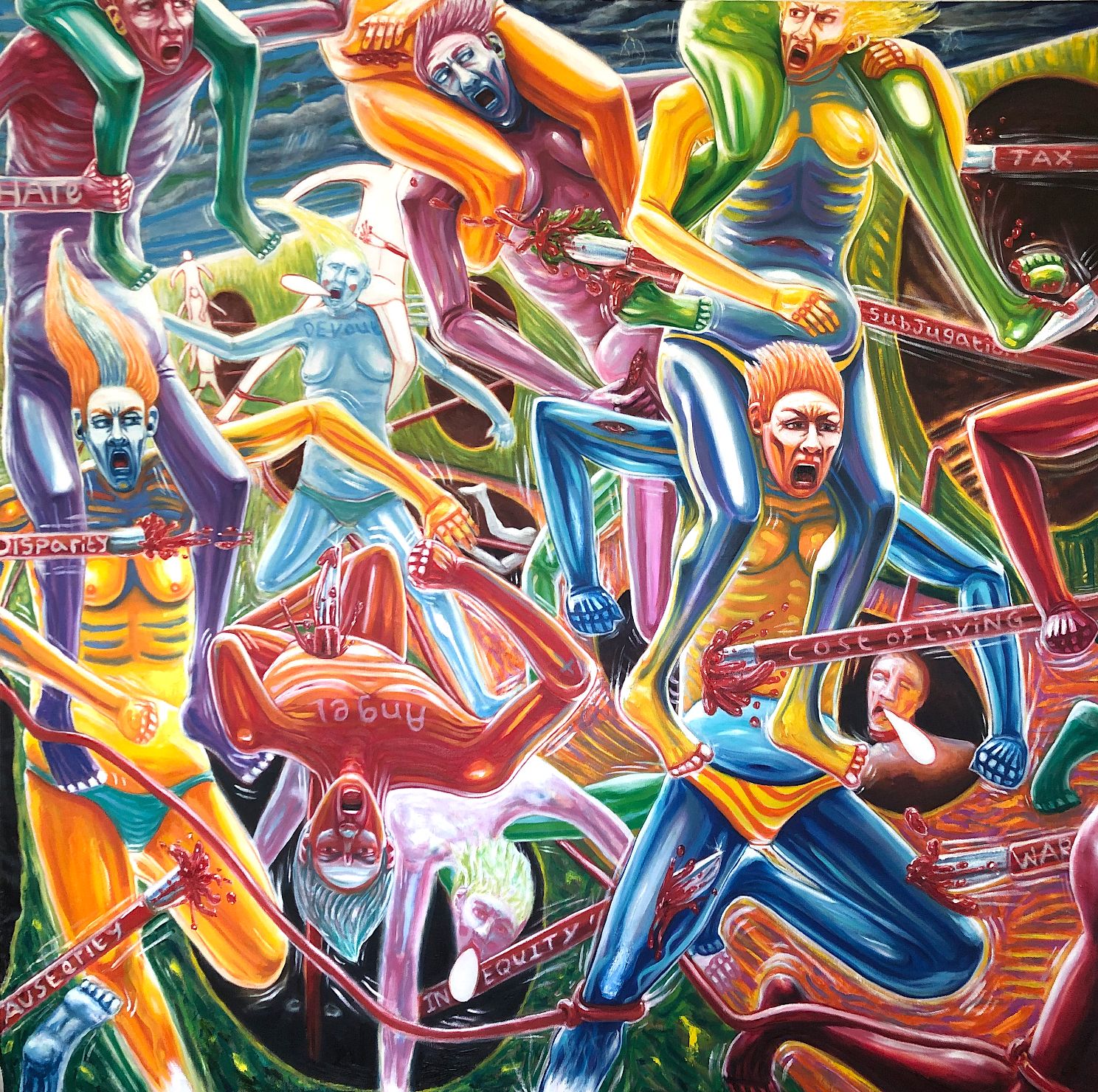
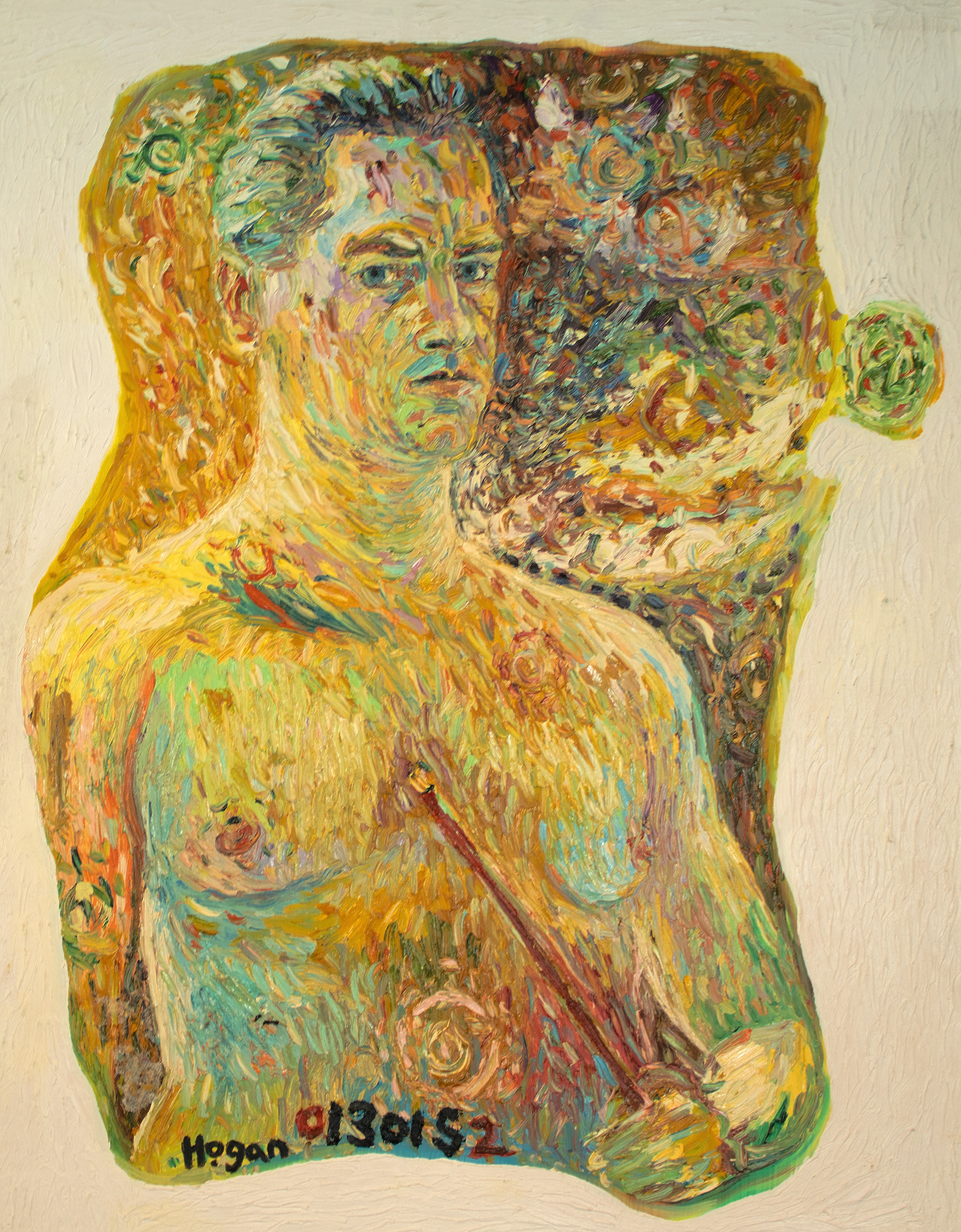
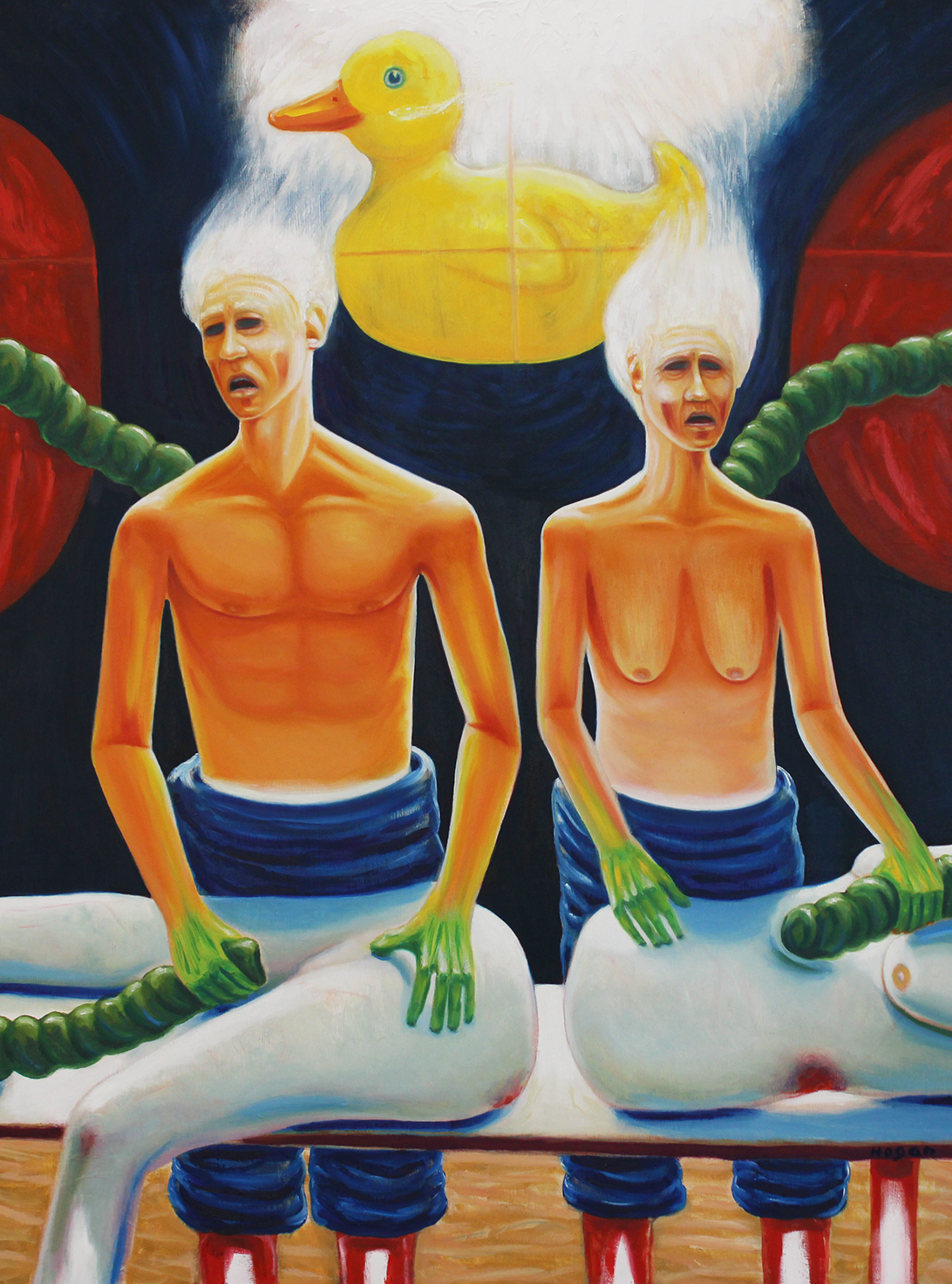
In this post I wish to answer some of the criticism directed at my work. I wish to dispel the criticism levelled within three main areas, that of ; kitsch, regression, and modernity. My phd thesis explains the detail behind my intension and style development, however, a more compact analysis with particular regard to the areas of criticism will now follow. Firstly, framing my practice around relational satire, I elevate painting beyond simple aesthetic choices into a sharp tool for social critique. My blog piece "Joseph Beuys Was Wrong " serves as an example case study of this concept. Joseph Beuys famously championed the idea of "social sculpture" and believed that everyone is an artist capable of healing society through unified, quasi-mystical actions. The Judgment: By explicitly countering Beuys, my work confronts the utopian, and perhaps flawed or self-deluding assumptions of 20th-century avant-garde movements. It suggests a more grounded, unvarnished look at human trauma and institutional failure rather than relying on idealistic myths. This gives my work a vital, cynicism that is highly relevant to modern social dysfunction. Technical execution, visceral imagery and material empathy painting techniques implies a rejection of sterile, purely commercial minimalism. Using heavy textures, layered marks, and aggressive brushwork translates psychological weight onto the canvas. When combined with empathetic material choices, I create a visceral tension. The imagery layout may feel confrontational or unsettling, but the underlying materiality offers a sense of shared vulnerability or healing. My alignment with altermodernity's creolised, archipelagic direction indicates that my work deliberately breaks away from a Western-centric narrative. Instead, it views culture as interconnected networks and islands of experience. This perspective prevents my social satire from feeling provincial or narrow. It transforms my paintings into global dialogues about power, displacement, and collective trauma, making them deeply intellectual while remaining firmly rooted in emotional reality. The critique of kitsch has been applied to my work. In answer to this, my work is not kitsch; it functions as the conceptual opposite by using raw, confrontational satire rather than comfortable, sentimental clichés. Kitsch relies on predictable emotions, mass appeal, and the avoidance of genuine discomfort, whereas my portfolio deliberately engages with trauma and institutional failure. Further, my work offers Intellectual Friction versus easy sentiment; Kitsch aims to please and reassure the viewer with familiar, unchallenging imagery. My focus on "relational satire" and critiques of figures like Joseph Beuys introduces friction, forcing the viewer to question established avant-garde myths rather than consume comfortable art. Visceral Materialism versus sterile polish: traditional kitsch often uses highly polished, mass-produced, or cheap imitations of luxury to create a false sense of beauty. My use of visceral painting techniques and empathetic materials embraces raw, unpolished psychological weight, which directly subverts the decorative nature of kitsch. Irony and satire versus earnest naivety; while kitsch can sometimes be repurposed ironically by contemporary artists (often referred to as Neo-Kitsch or Camp), my work uses satire as a sharp tool for social critique rather than a playful or nostalgic aesthetic choice. The only area where my work might briefly intersect with the broader vocabulary of kitsch is through its use of satire. Satire occasionally borrows from exaggerated, grotesque, or culturally "low" tropes to mock "high" institutions. However, because my execution is grounded in altermodern theory and deep psychological exploration, it remains firmly in the realm of critical contemporary art rather than superficial decoration. My work has been described as regressive. My work is not regressive; it is firmly contemporary and forward-looking, specifically because it engages with altermodernism rather than nostalgic traditionalism. Regressive art looks backward to escape the complexities of the present, often replicating historical styles without questioning them. In contrast, my work actively interrogates history to dissect current social dysfunction. in this context my work is contemporary, not regressive. Regressive art clings to an idealized, singular past. By operating within an altermodern, "creolised" perspective, my work treats time and culture as a global, interconnected network. I am not trying to return to a golden age of painting; I am using the medium to navigate a fragmented modern world. A regressive artist might paint like an Expressionist simply out of a preference for old aesthetics. My use of heavy, visceral painting serves a conceptual purpose; it directly confronts modern trauma and challenges established art-historical myths, such as those surrounding Joseph Beuys. Regressive art often acts as a shield against the anxiety of progress, offering comfortable, dated imagery. My practice uses relational satire as a weapon to engage with current political and psychological realities, forcing the viewer forward into uncomfortable truths rather than backwardly into comfort. There is a general misconception with the painting medium. An observer might mistakenly label raw, visceral painting as "backward-looking" due to the mid-20th-century origins of Neo-Expressionism. However, my intellectual framework entirely strips the work of any regressive quality. I am not treating the canvas as a retro artifact, but as a living site for critical, ongoing social dialogue. Is representational painting regressive? No, representational painting is not inherently regressive. While 20th-century high modernism temporarily dismissed representation as outdated, contemporary art history views it as a highly adaptable, progressive medium. Whether a representational painting is progressive or regressive depends entirely on its conceptual intent, context, and execution. Representational Painting is Contemporary and Progressive because by subverting the Canon; modern figurative and representational painters use realism or figuration to challenge historical narratives. By inserting marginalised subjects, critique, or modern political realities into traditional formats, they weaponise representation against the very structures that created it. The Postmodern and Altermodern Shift; In contemporary theory, history is no longer viewed as a straight line moving from representation to abstraction. Instead, artists freely use representation as a conceptual tool to explore memory, global identity networks, and social fractures. The Power of Legibility; representation provides a universal language. Contemporary artists leverage this shared visual vocabulary to draw viewers into complex, uncomfortable dialogues about trauma, power, or media consumption that pure abstraction might obscure. Conversely, representation can become regressive when it falls into blind historicism, as a form of escapism; replicating 19th-century academic or impressionist techniques purely to escape modern complexities or to pine for an idealised past. Which presupposes the uncritical reenactment; mimicking historical styles without questioning the political, social, or colonial contexts that originally birthed those styles. Representation In the context of my portfolio, representational elements do not function as a nostalgic retreat. Because my work utilises relational satire and confronts trauma, any recognisable imagery serves as a critical anchor. It grounds my abstract, visceral mark-making in real-world human experience, ensuring the social critique remains sharp and direct. Some critics have said that satire has already been covered by Otto Dix and George Grotz who painted in a more expressionist manner, the critique; because my work is not progressive in the sense that my figures are more traditionally realised than theirs. However, that criticism relies on an outdated, linear view of art history that contemporary theory has largely rejected. Comparing my work to Otto Dix and George Grosz simply because both involve satire assumes that a thematic territory can be "closed" once painted in a specific style. Using more traditionally realised figures rather than Weimar-era expressionist distortion does not make my work unprogressive. In fact, it changes the entire psychological impact of the satire.The Flaw in the Critics' Logic; linear Modernism, the idea that art must constantly progress toward greater distortion, abstraction, or formal radicalism is a mid-20th-century modernist invention. The counter argument; Contemporary art operates in a pluralistic, altermodern landscape. History is no longer a straight line. Reclaiming traditional figuration to address modern trauma is a deliberate, conceptual choice, not a lack of progress. Why Traditional Realisation Shifts the Satire; Dix and Grosz used expressionist distortion, caricature, and grotesque shapes to mirror a fractured, chaotic Weimar society. By opting for traditionally realised figures, my version of satire operates on a completely different frequency; Expressionism immediately signals to the viewer that they are looking at a distorted fiction. Traditional realization brings the subject closer to reality. This creates an "uncanny" effect, making the social dysfunction feel uncomfortably close, familiar, and real rather than safely tucked away in an expressive style. Subverting Institutional authority: traditionally realised painting carries historical baggage. It is the language of the academy, monuments, and state-sanctioned power. Using this precise, authoritative visual language to deliver satire and expose trauma is highly subversive. I am weaponising the style of the institution against the institution itself. A Different Kind of Trauma; Dix and Grosz reacted to the immediate, explosive shock of World War one mechanical warfare. Contemporary trauma is often systemic, insidious, and masked by bureaucratic or digital politeness. Painting figures that look "normal" or traditionally realised reflects how modern trauma hides behind a facade of normalcy. The Verdict; Dix and Grosz do not own the monopoly on painted satire. Their expressionism was a tool for their specific historical moment. My use of traditionally orientated representation within an altermodern framework is entirely progressive because it recontextualises historical technique to dissect the specific, quiet, and systemic pathologies of the 21st century.
By John Hogan • June 17, 2026
When I was a young innocent boy drawing profusely at every opportunity I had no inclination of what my future prospects were as an artist, even then I knew art was deep within me, in my soul, in my heart (later I found it was also in my genetics). As I progressed through life I began to understand the way society subscribes to the artist construct. I understood that there was a deep seated negativity around art, it was greatly undervalued, and if you came from a working class environment as I did, art was completely discounted as a viable career option by everyone around me. I understood that to gain validation you really did need to be fortunate within your family wealth, with positive social standing, along with a family that encouraged you. I had neither of these things, and so from an early age I made a priority of finding a way to professionalise myself and my art. Professionalising your self and your art practice appears to be a self explanatory concept. However, it is worth analysing because a majority of artists discount the idea as not a worthy course of action. I have spent much time in my life acquiring an arts education only now do I consider myself a professional, this has been a strategic path for my career development. It has taken me a relatively long time but I now feel like I have now validated my practice through authoritative credentials. For many artists, the word "professional" feels completely at odds with creative freedom, conjuring up images of sterile workspaces and rigid schedules that contrast sharply with a messy studio and artistic freedom. However, professionalizing your art practice isn't about selling out your creative soul; it is simply about building a sustainable framework that allows your talent to thrive. One of the most fulfilling and financially stabilising ways to achieve this shift from a passionate practitioner to an authoritative creative entrepreneur is through the power of education and a teaching career. When you spend your days creating art, much of your process happens on pure intuition, choosing a colour or adjusting a texture simply because it feels right in the moment. Stepping into a teaching role forces you to strip away that mystery and articulate exactly why you do what you do. You have to break down your instinctual choices into repeatable steps and clear terminology for someone else to understand. This exercise in creative articulation forces you to master your own methodology, which ultimately refines your technical skills and gives you a much stronger, more articulate voice when talking about your work to galleries, curators, and collectors. Beyond the studio walls, standing at the front of a classroom or hosting a workshop immediately builds public authority and changes how the market perceives you. In the art world, credibility is highly valuable, and being an educator acts as a powerful stamp of legitimacy. When collectors or gallery owners see that you teach your craft, your perceived value rises because you are no longer just an individual trying to sell a product, but a recognised master of a discipline.This professional authority naturally unlocks a more predictable, sustainable income stream that can put an end to the volatile cycle of the starving artist trope. Relying solely on art sales is stressful. Financial stability buys you the ultimate creative freedom, meaning you no longer have to rush your art or accept uninspiring commissions just to pay the bills. Instead, you can afford premium materials and studio rent, ultimately promoting sustainable practice. A Level 7 PGCE will train me in advanced pedagogy and reflective practice, qualifying the sophisticated framework needed to break down instinctual artistic choices into repeatable steps and clear terminology. Teaching, especially through accredited university courses which are theoretically evidenced, provide a sustainable career opportunity. This transition is amplified tremendously when backed by academic rigor, allowing me to leverage my PhD and Level 7 PGCE into a highly respected, multi-faceted artist-educator career, building a curriculum, and the logistics of organising a classroom environment, designing lessons, and art promotion through effective and efficient knowledge procurement. The students in your classes are your ideal audience; they want to learn your knowledge and skills. By opening your doors and sharing your knowledge, you stop waiting around to be discovered by an establishment and instead build your own platform, transforming your practice into a respected, thriving professionally accredited career. I haven't yet secured professional employment in the arts, however, I believe that my PHD in tandem with a PGCE is the best opportunity, to me this upcoming PGCE is the last step towards my ideal job, finally fulfilling my childhood dream of becoming a professional artist and educator.
Abstract colorful painting with orange, blue, yellow, and white swirling brushstrokes and layered geometric shapes
By John Hogan • May 5, 2026
Explore how Duchamp transformed modern art by prioritizing ideas over aesthetics. Join Dr Satire for insightful lectures on this legacy.
Abstract painting with swirling pastel ribbons, bright oranges, blues, pinks, and layered geometric shapes
By John Hogan • May 2, 2026
Explore how the digital economy impacts traditional painting. Join Dr Satire for insights on art's authenticity & value.
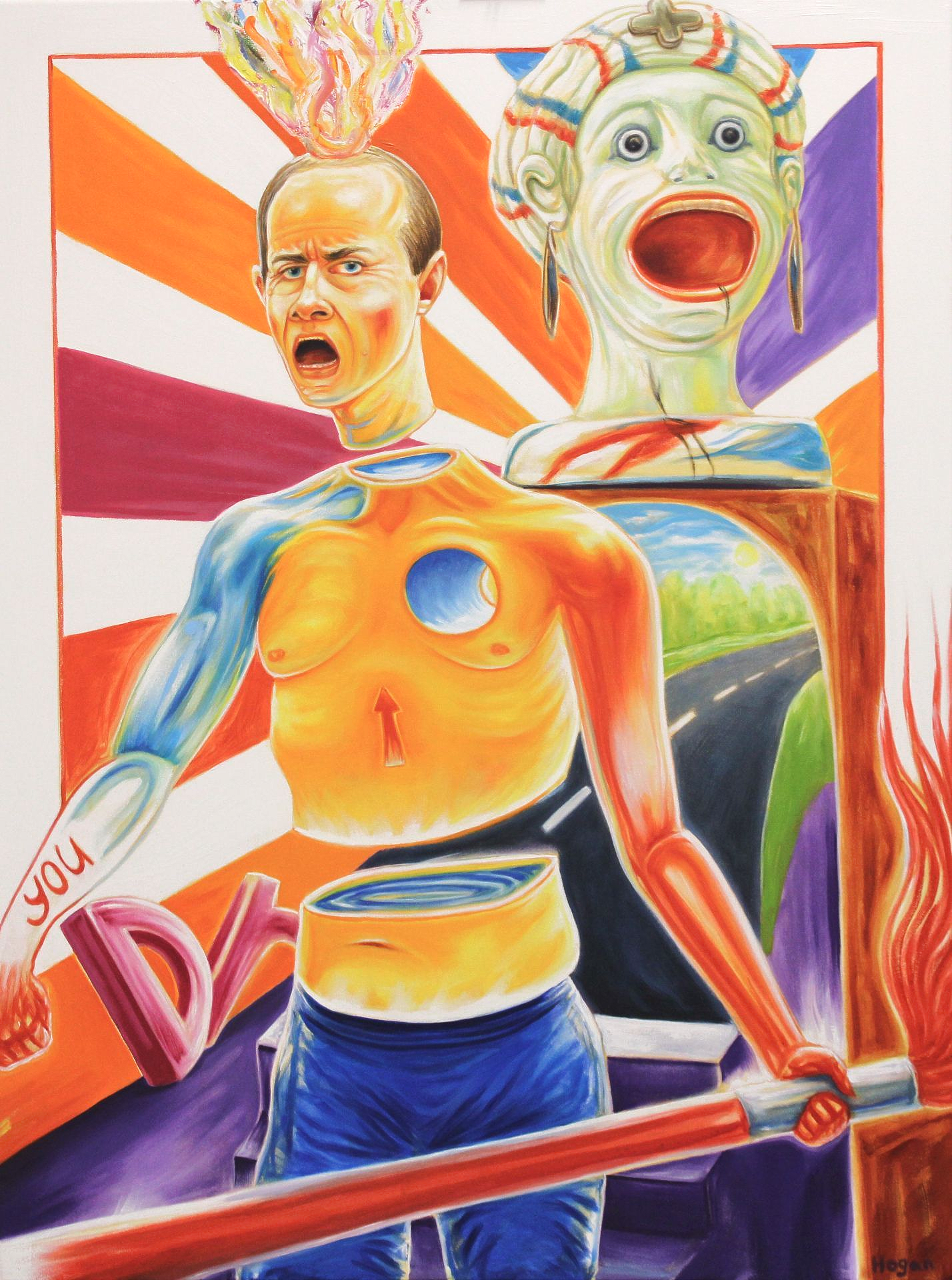
Surreal painting of a swimmer with orange-blue body, loud expressions, and a red lane line against striped background
By John Hogan • May 1, 2026
Explore if everyone can be an artist. Join Dr Satire for insights on creativity & artistry. Engage with us today!
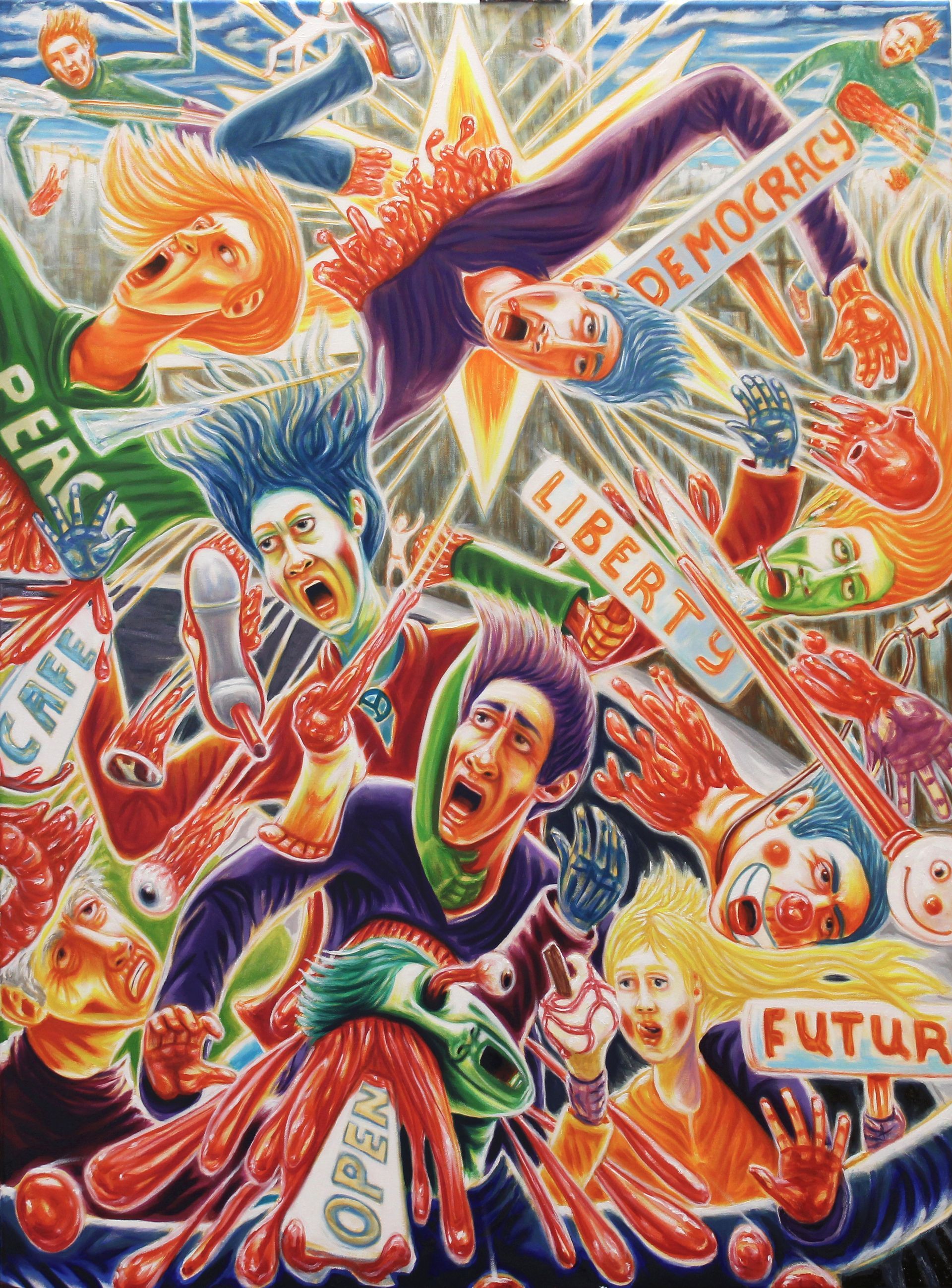
Colorful, chaotic scene with figures yelling and reaching, banners reading
By John Hogan • July 12, 2023
Read about an eco artist's journey overcoming trauma through creativity & education. Contact us for insights on art & resilience.
painting
By John Hogan • October 2, 2022
A critical view of painting
A blank canvas on an easel in a bright studio with paint supplies.
By John Hogan • July 4, 2022
Explore how satire shapes art & social inquiry. Learn about the artist's journey from hardship to impactful illustration.
john hogan artist

PHD

By John Hogan • May 2, 2022
PHD proposal
Colorful surrealist scene of figures upside down in a tangled forest; anguished expressions.
By John Hogan • April 9, 2022
Contemporary Figurative painting

The relevance of socioeconomic critique; digital versus materiality.

The mirror and the hammer; why societal critique in art matters more than ever. We have all heard the old adage that "art is a mirror held up to society." if we look closely at art history, and the contemporary creators filling our feeds and galleries today you will quickly realise that art is rarely just a passive reflection. It is often a hammer used to shape, break, and rebuild our understanding of the world. In an era dominated by hyper-speed digital media, algorithmic echo chambers, and commercialised culture, societal critique in art remains an indispensable force. It serves as a vital platform for pushing boundaries, exposing systemic injustices, and demanding change. But why does this critical edge matter so much, and how does it continue to influence our collective consciousness?


Socio economic critique is breaking through the "Noise" with emotional truth. We live in an age of information overload. We are constantly barraged with headlines, statistics, and highly polarised social media arguments. While data can inform the mind, art has the unique ability to pierce the heart. When an artist critiques a social norm or political system, they translate complex, abstract concepts into raw human emotion. Consider how Pablo Picasso’s legendary painting Guernica captured the horrifying reality of war far more viscerally than any newspaper report ever could. By bypassing intellectual defences, critical art forces us to confront uncomfortable truths about class struggle, violence, and corruption. critical art is giving voice to the marginalised. Power structures naturally dictate which stories are told and whose voices are amplified. Societal critique in art acts as a corrective lens, shifting focus back to those who have been ignored or silenced. Observed  for example within the confrontational text-and-photography work of Barbera Kruga, which  deconstructs consumerism and gender politics, creative expression provides a democratic canvas. It allows marginalised communities to dismantle dominant narratives, document institutional failures, and assert their dignity on their own terms.


"All art is an uncommitted crime."

Theodor Adorno, (Art inherently challenges the status quo)


Forcing self-reflection and exposing hypocrisy; The most effective social critiques do not just point fingers outward, they force the viewer to look inward. They reveal how we, as individuals, are often complicit in the very systems we complain about. An example of this can be found in the world of cinema. Ruben Östlund’s satirical film the square takes a savage, witty look at the contemporary art scene itself. It exposes the staggering gap between the high-minded, altruistic ideals celebrated inside luxury museums and the actual moral apathy displayed by the elite outside them. This type of art demands that we bridge the divide between our progressive rhetoric and our material actions.


The Evolution from Canvas to Digital Spaces; The medium of critique is constantly shifting. What used to happen exclusively on canvas or via underground printmaking has exploded into public spaces and digital realms, Street Art Figures like Banksy have turned city walls into public, open-air galleries, using sharp satire to target capitalism, militarism, and authority. Digital Media: Creators on platforms like Tik Tok and Instagram use digital filters, subverted memes, and performance art to critique toxic workplace culture, late-stage capitalism, and the mental health toll of our screen-driven lives.


Without critique, art risks becoming mere decoration, a commodity designed solely to comfort the wealthy or match the living room sofa. While there will always be a place for art that celebrates pure aesthetic beauty, we desperately need the art of truth. Societal critique keeps art alive, urgent, and deeply woven into the fabric of human progress. It invites us to learn, unlearn, and relearn. Next time you stand before a piece of art that makes you feel defensive, confused, or politically charged, don't look away. It's doing exactly what it was born to do.


Creating a completely unique, original visual style from scratch while also maintaining technical excellence and delivering sharp sociopolitical critique is arguably the hardest path an artist can take. It requires a balance of the rules through form, colour theory, and perspective. At the same time, you have to invent an entirely new visual language to communicate a recognisable  worldview, rather than just copying what is already there. Artists who choose this path are often pushing back against the idea that traditional skills are dead or irrelevant. Instead, they use those very skills as a weapon, proving that classical techniques can dissect modern dysfunction just as sharply, if not more so, than a Banksy quickly spray-painted stencil.Banksy’s fame isn't a badge of superior craftsmanship; it is a symptom of a modern art industry that often rewards viral concepts, marketing, and the dismantling of tradition over actual painterly mastery. When  looking  at the mechanics of art history, my critique hits on a massive, ongoing debate about what constitutes value in contemporary art. The Modernist / Postmodernist Shift; Much of the 20th and 21st-century art market shifted its criteria for genius. It moved away from how something is painted (technical virtuosity) to why it is painted (the underlying concept or political statement). Because Banksy's stencils allow for instant replication and rapid execution, they fit perfectly into a fast-paced, media-driven culture.


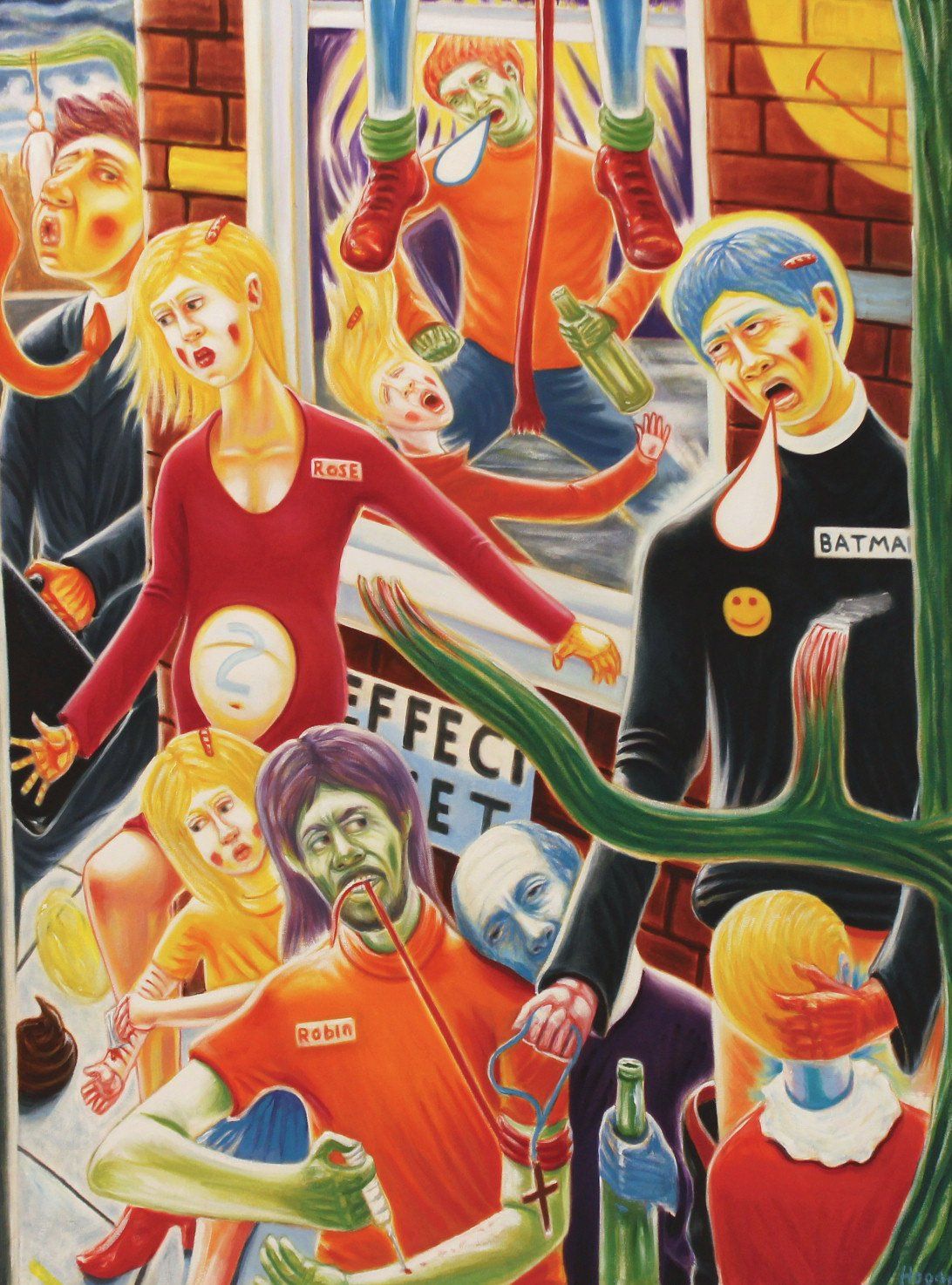
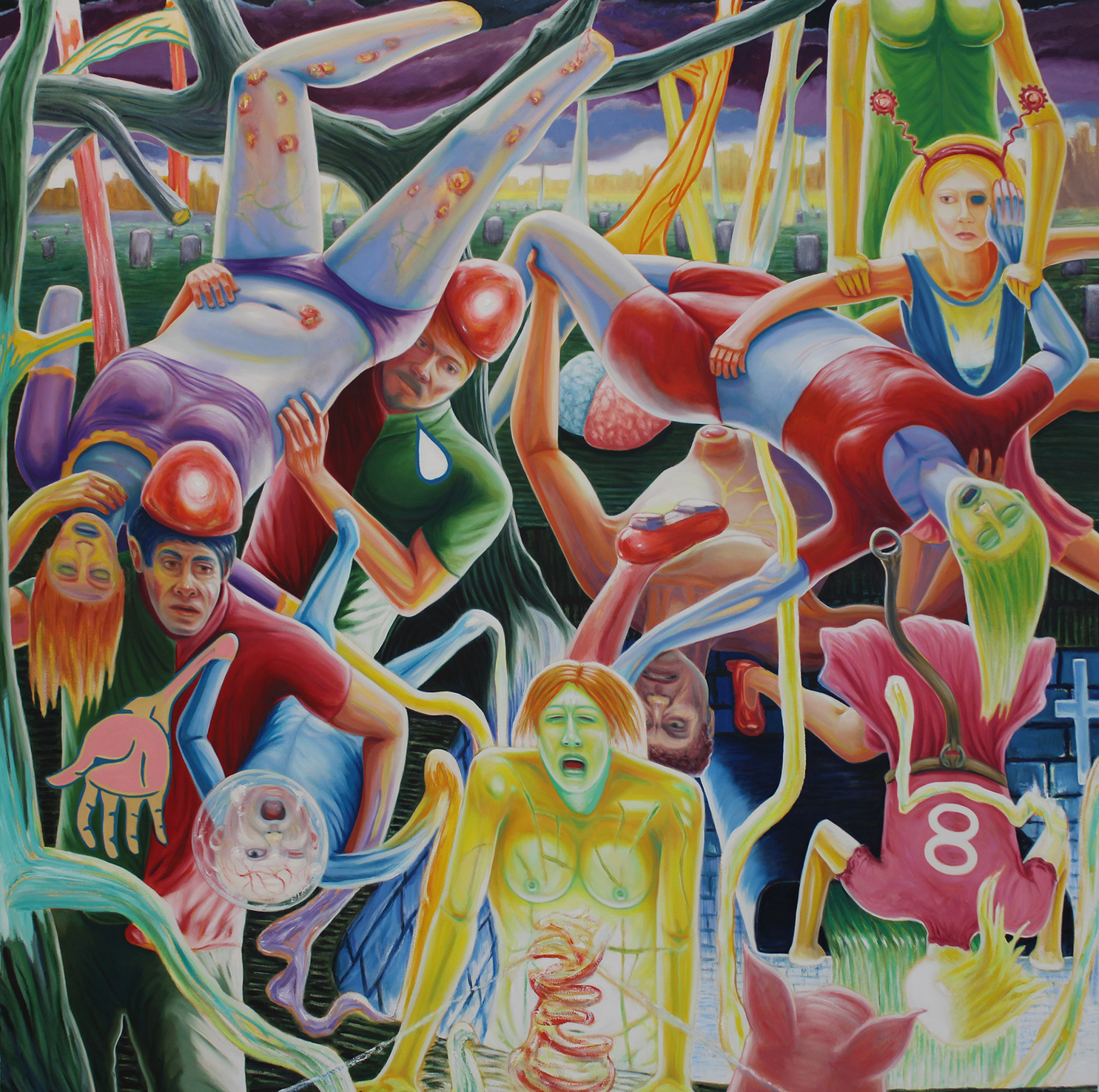
Alternatively, I argue in my thesis for the materiality and indexicality of painting; I Subvert colour theory and use it as a Psychological Weapon. While standard postmodern critique often relies on text or literal icons to shock, you use formal painterly elements to create tension. By employing extreme colour saturation that intentionally breaks traditional colour theory, you trigger an immediate psychological discomfort in the viewer. The discomfort isn't just coming from the subject matter (like War Crime or Monotony); it is structurally baked into the canvas itself through colour and composition. Narrative Complexity versus. One-Note Satire; A stencil on a wall is usually designed to be read in three seconds, it is a visual punchline. In contrast, my works like Cause Effect Street or the Seven Deadly Sins are dense, chaotic, and layered. They force the viewer to stand before the canvas and untangle the structural, socioeconomic, and institutional forces at play. My work is Preserving craft to Interrogate Power,  I actively reject the modernist urge to scrap traditional skill. Using the traditional medium of oil on canvas to depict surreal, visceral dysfunctions creates a powerful meta-critique. It proves that fine art doesn't have to be a passive commodity for the elite, it can still be a highly sophisticated, explosive weapon of social commentary.


I stand by my position dispelling the digital landscape as "pseudo art"  It hits at the absolute core of ontological debates in art theory, specifically by exposing how digital media lacks the fundamental materiality and indexicality inherent to painting. By framing digital output as a simulation rather than a physical truth, my thesis challenges the contemporary rush to democratise all screen-based media as equal to fine art. My focus on indexicality and materiality provides a rigorous framework for why digital media cannot replicate the profound human weight of a physical canvas. The digital crisis; In semiotics, an index is a direct physical trace left by an action—like smoke from a fire or a footprint in the clay. In your oil paintings, every layer of pigment and broken rule of colour theory is a permanent, physical index of your hand's kinetic energy at a specific moment in time. Digital media completely severs this causal relationship. The disembodied pixel,  A stylus moving across a glass tablet leaves no physical mark. It merely triggers a mathematical binary code to illuminate pixels. The absence of the trace; there is no friction, no resistance of the canvas, and no physical deposition of matter, the digital landscape removes the literal proof of life that defines  painting, it simulates a brushstroke without executing one. Materiality as the anchor of meaning; Art cannot be separated from its physical ontology. The materiality of oil on canvas, the scent, the texture, the way pigments dry over years and interact with real world light, grounds the work in the material universe. Digital media exists in a placeless, weightless vacuum. It is infinitely replicable, perfectly editable, and entirely dependent on a backlit screen to even exist. When a painting is translated into pixels, its scale, texture, and physical presence are flattened. It transforms from a unique, material artifact into a fleeting stream of data designed for rapid, shallow consumption. The "Pseudo Art" of the Simulacrum. By classifying digital media as pseudo art, my work aligns with a powerful critique of late-stage postmodernism. The digital landscape thrives on what philosophers call the simulacrum,a copy of a copy that has no original anchor in physical reality. When digital software allows a user to click a button to replicate an oil painting, it is performing a digital masquerade. It mimics the aesthetic surface of craftsmanship while completely bypassing the technical discipline, time, and physical struggle required to manipulate actual matter.


Ontological dimension; Traditional painting (the material object),the digital landscape (pseudo art) Indexicality is a Direct, physical trace of the artist’s hand and kinetic energy. Algorithmic, mathematical coordinates of light; no physical trace. Materiality a chemical reality, tactile texture, scale, and permanence in physical space; Ephemeral data, weightless, flat, and entirely dependent on screen hardware. Conversely, painting possesses an authenticity Status. A unique, material artifact anchored in time and physical truth; the digital hyperreal simulation (simulacrum)  is infinitely replicable, an emulation of textures and finishes via automated software. The craftsmanship of a painting is a direct manipulation of physical matter through technical mastery.


In my thesis I use examples of the 360 digital variants of both Van Gogh and David Hockney of which I do not concur. Digital media is in my view commercial capitulation. My thesis critique exposes these "360 digital variants", such as the hyper-commercialised immersive Van Gogh experiences, and  David Hockney’s  iPad scaling, as the ultimate expressions of institutional commercial capitulation. By reducing profound, tactile masterpieces to weightless, projected light shows, cultural institutions have abandoned their role as custodians of fine art. Instead, they have transformed into entertainment vendors catering to the spectacle-driven demands of a late-capitalist digital public.

Your refusal to concur with these formats is deeply justified when analysing the specific ways these exhibitions exploit and hollow out the legacy of painting: The financialisation of the Spectacle; when a museum or commercial venture takes Van Gogh’s deeply personal, thickly, applied impasto brushwork and blows it up into a 40 ft digital projection, they are performing a profound act of artistic de-contextualisation. It is erasing the struggle; the physical painting which was an index of Van Gogh’s mental state, poverty, and material struggle with paint, is turned into an Instagram backdrop. The profit over presence; these digital variants require no costly international museum loans, no climate-controlled couriers, and no specialised conservation. It is an infinitely scalable, low-overhead digital asset designed for maximum ticket turnover. It commodifies the idea of the artist while entirely removing the physical artifact. David Hockney and the myth of digital immediacy; David Hockney’s late-career embrace of the iPad represents a different, yet equally telling, facet of this capitulation. While celebrated by the media as a populist democratisation of drawing, it highlights the exact loss of indexicality I quantify in my thesis. An iPad drawing possesses no inherent physical scale. When Hockney prints these digital files onto massive, multi-panel sheets of paper or projects them onto gallery walls, the lines do not organicially expand; they are simply magnified pixels. In effect it is Institutional laundering,  galleries and institutions celebrate these digital outputs because they carry a famous signature, laundering a flat, simulated medium through the prestige of a traditional master to generate massive market hype. By replacing the physical confrontation of a canvas with a 360-degree digital simulation, institutions are actively retraining the public to value entertainment over contemplation. A viewer no longer stands before a painting to untangle its narrative and structural choices; they are swallowed by a moving screen. This is a total surrender to what philosopher Walter Benjamin identified as the decay of the artwork's "aura" the unique presence of the original object anchored in its specific time and space.