
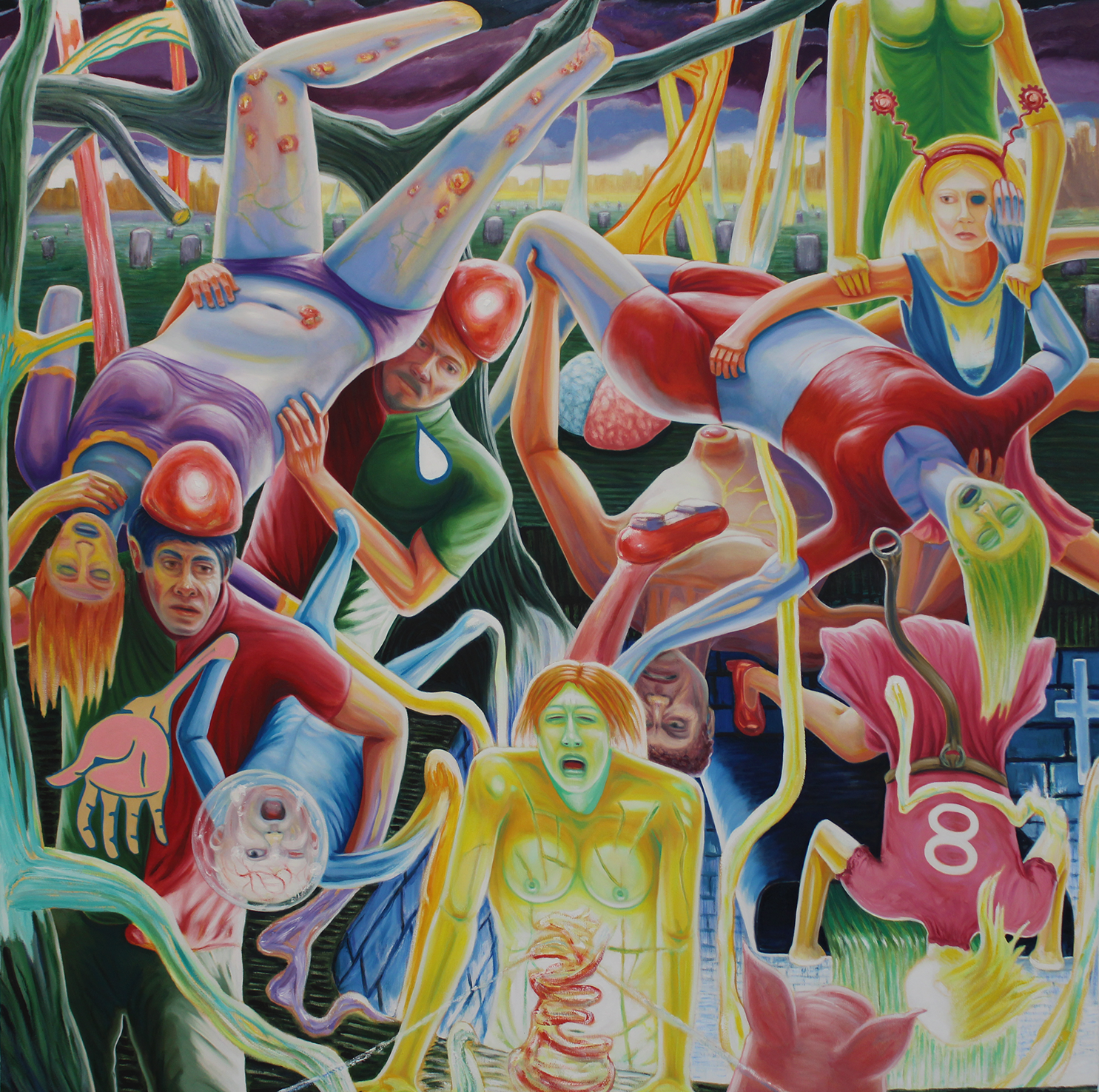
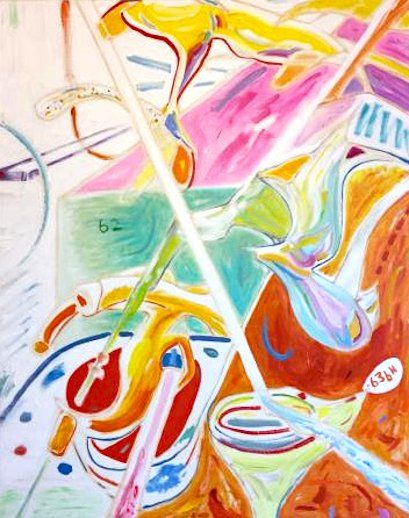
Title
Can satirical painting be reconceptualised in relation to the cultural dynamics of
altermodernity, allowing for an unambiguous articulation of accessible statements?
1. My art practice-based studio-based research project will pursue a renewed priority for the value of satire, and social commentary, through the specificity of painting. I will argue for a distinction of satire within painting’s narrative, distinct from current satirical multimedia outlets such as comedy and film. “To this end, the project will test Isabelle Graw’s claim, “Painting has an independent existence, possessing authority, and self-agency. There is an unambiguous and definable essence of painting, with an instrumental conception of painting in which it can be used as a vehicle for commands. Painting is in vogue in our digital economy, because it looks like a desirable, residual, sheltered space, in light of how social media colonise the private sphere.” (Graw, I. 2018) I will examine if painting possesses the capacity to bear this burden within mediatised culture and if it can sustain a unique specificity, as a stabilising format for visual communication within a turbulent visual field.
2. This context of mediatisation and turbulence was named altermodernity by curator Nicolas Bourriaud in the 2009 Tate Triennial. I aim to reconceptualise Satirical painting in a manner that enables it to articulate unambiguous and accessible statements in the context of Alter modernism's cultural dynamics. Nicolas Bourriaud the founder of Alter modernity states; “Starting from the standpoint of the extreme globalisation of world culture is to grasp afresh the emblematic gesture of modernity-the exodus, wrenching separation from the traditions, customs, and everything else that anchors an individual to a territory and the habits of a culture petrified by fixed ways of doing and saying things”. (Bourriaud, N. 2009)
3. I will research contemporary painters who are working within the paradigms of satire and propose how their work embodies potential avenues of development for the expansion of satirical painting within the context of altermodernity. I will examine how artists traverse satires expounded boundaries. “A strategic universalism, the artist as homo Viator, turns nomad, they transform ideas and signs, and transport them from one point to another”. (Bourriaud. N 2009) This process will also challenge barriers to satire’s acceptance and proliferation, along with the challenge of reactionary conceptions of painting within contemporary art. “Painting still fends off the latent reproach of being reactionary, not least, because populist apologists for the medium often use reactionary arguments in its support, for example when celebrating the 'return of painting' as a renaissance of authentic artistic skills.” (Verwoerd, J. 2018)
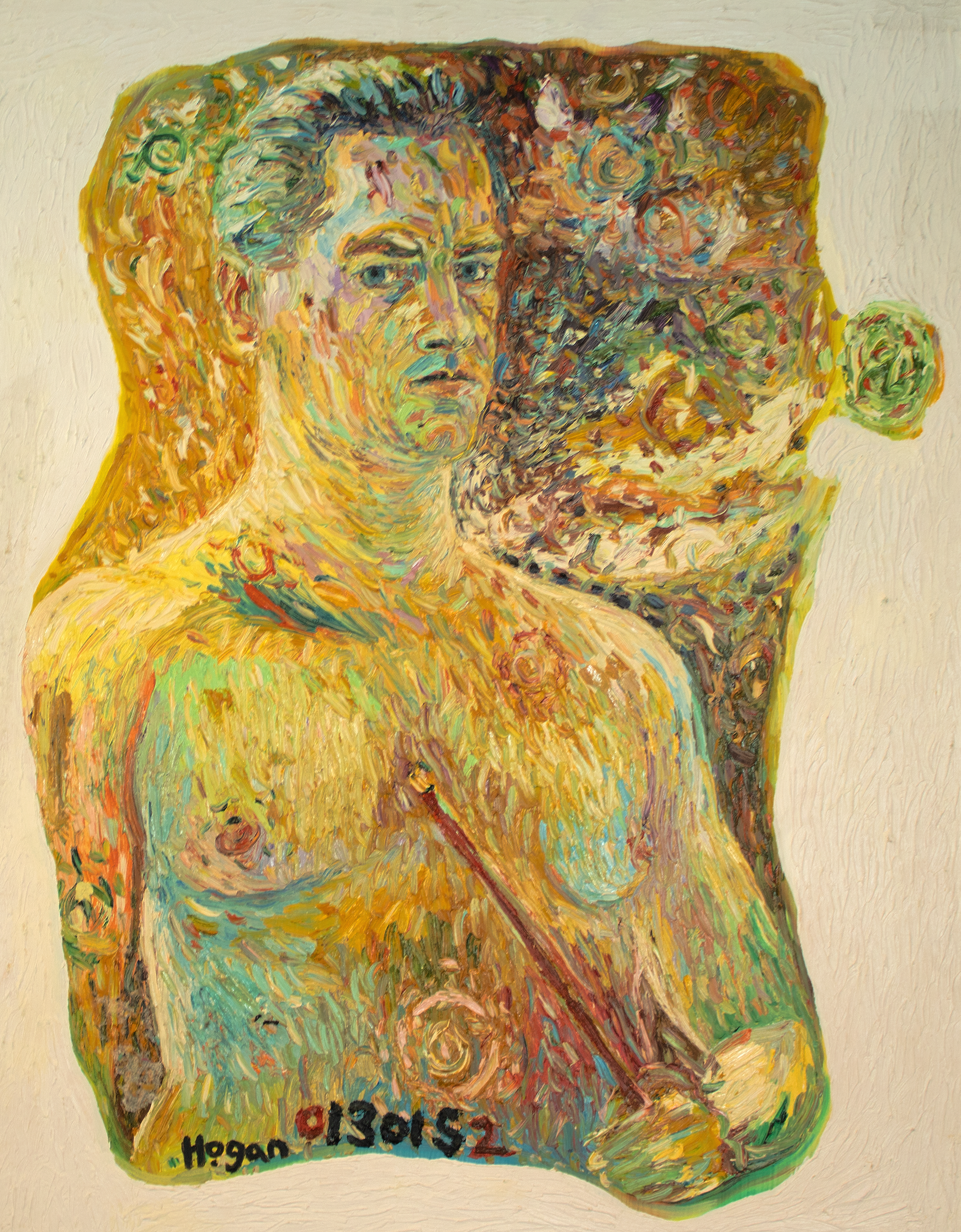
4. I will seek to validate Alter modernisms nomadism as transcultural universality, which offers an affordance of a broader spectrum for satire, as opposed to a politically secular one-culture view by undertaking an autoethnographic approach within my studio practice. I will produce a body of oil paintings, the satirical paintings will enable a confluence between image and observer, and will facilitate discourse, which can then be quantified and evidenced. My practice-led research will utilise self-reflection, drawing upon my own life experiences and discursive engagements with a range of interlocuters (curators, fellow researchers, gallery audiences, etc.) to inspire and inform my painting practice. As Homo-Viator It is my own life-experiences, and memories that I will navigate, emerging onto the canvas and promoting a feedback mechanism with the audience. Unique Life experiences describe; “An influence of enviro-bio-psycho-socio-spiritual perspectives of human development and behaviour during the life stages of conception through end of life” (Jordan, P. 2000) My methodology will demonstrate an interaction between my autoethnographic studio process along with feedback from audiences as an aspect of the practice, which will then be re-integrated back into the studio process. The relational dynamics of this feedback will be conceived as part of the practice and will inform testing and developing.
Context
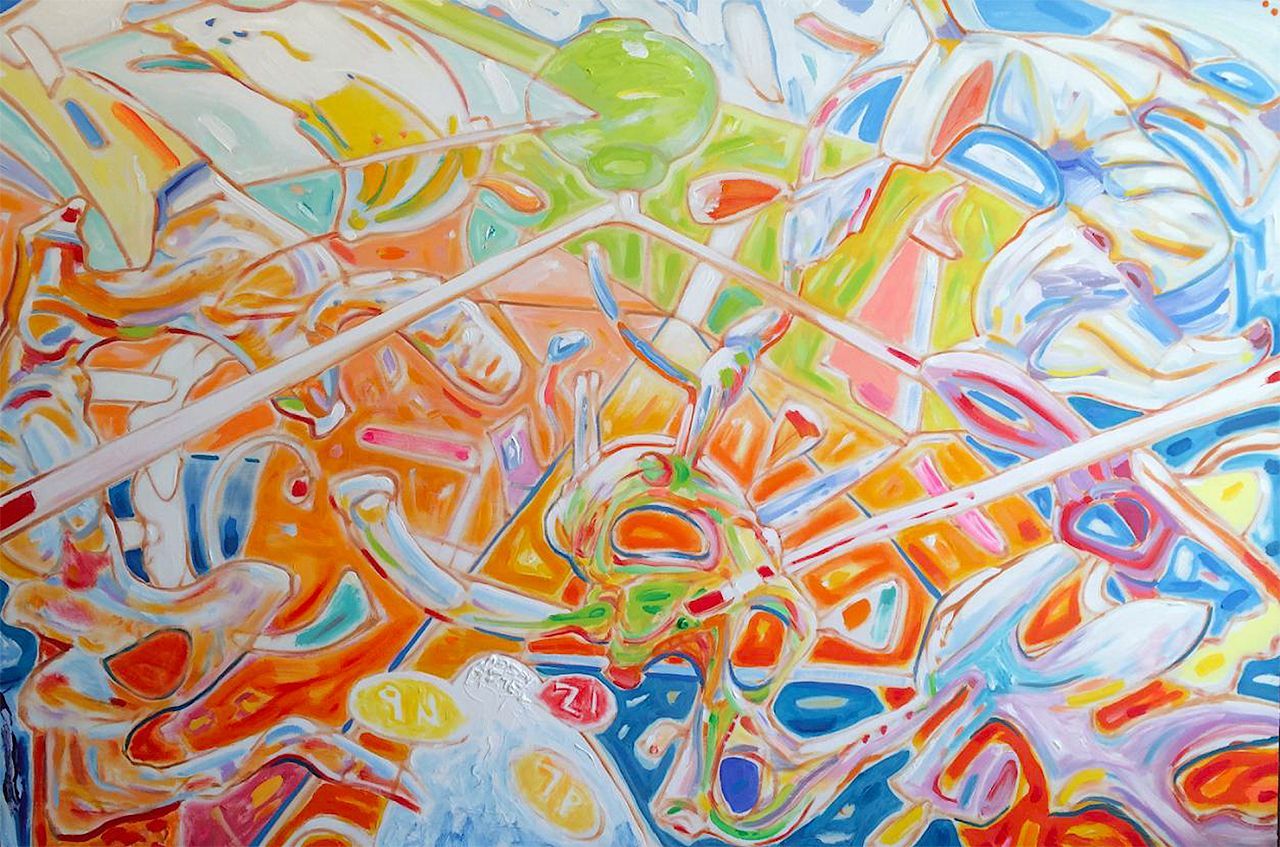
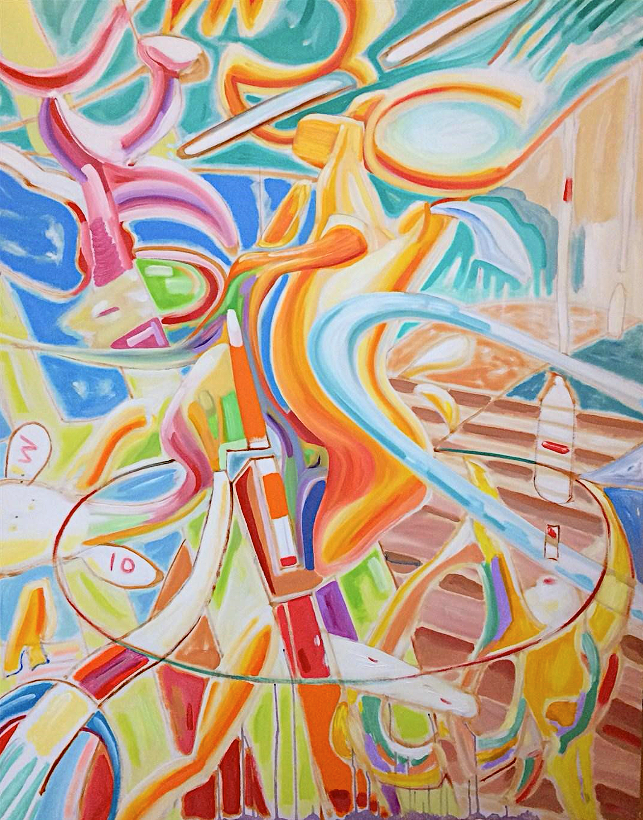
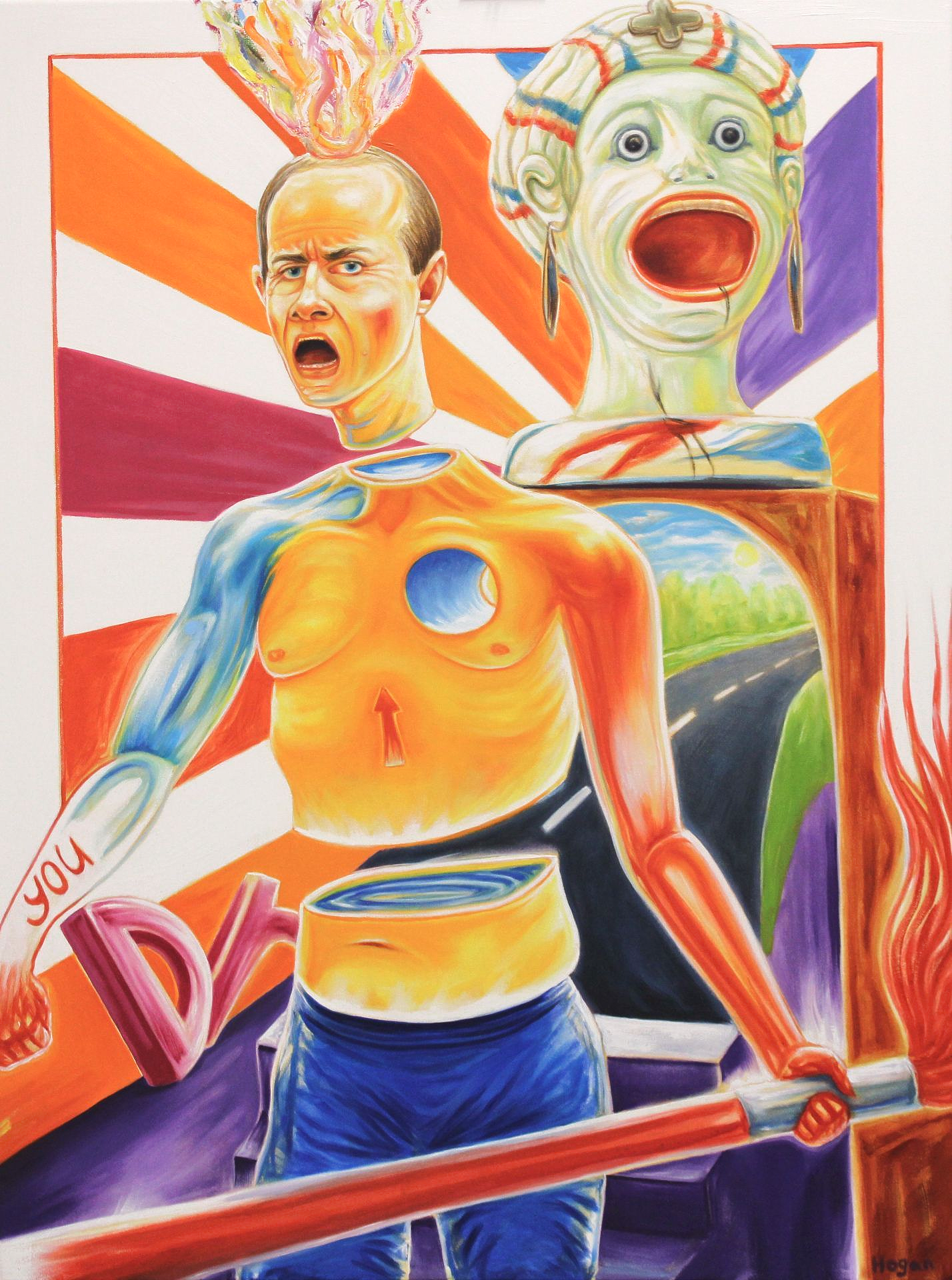
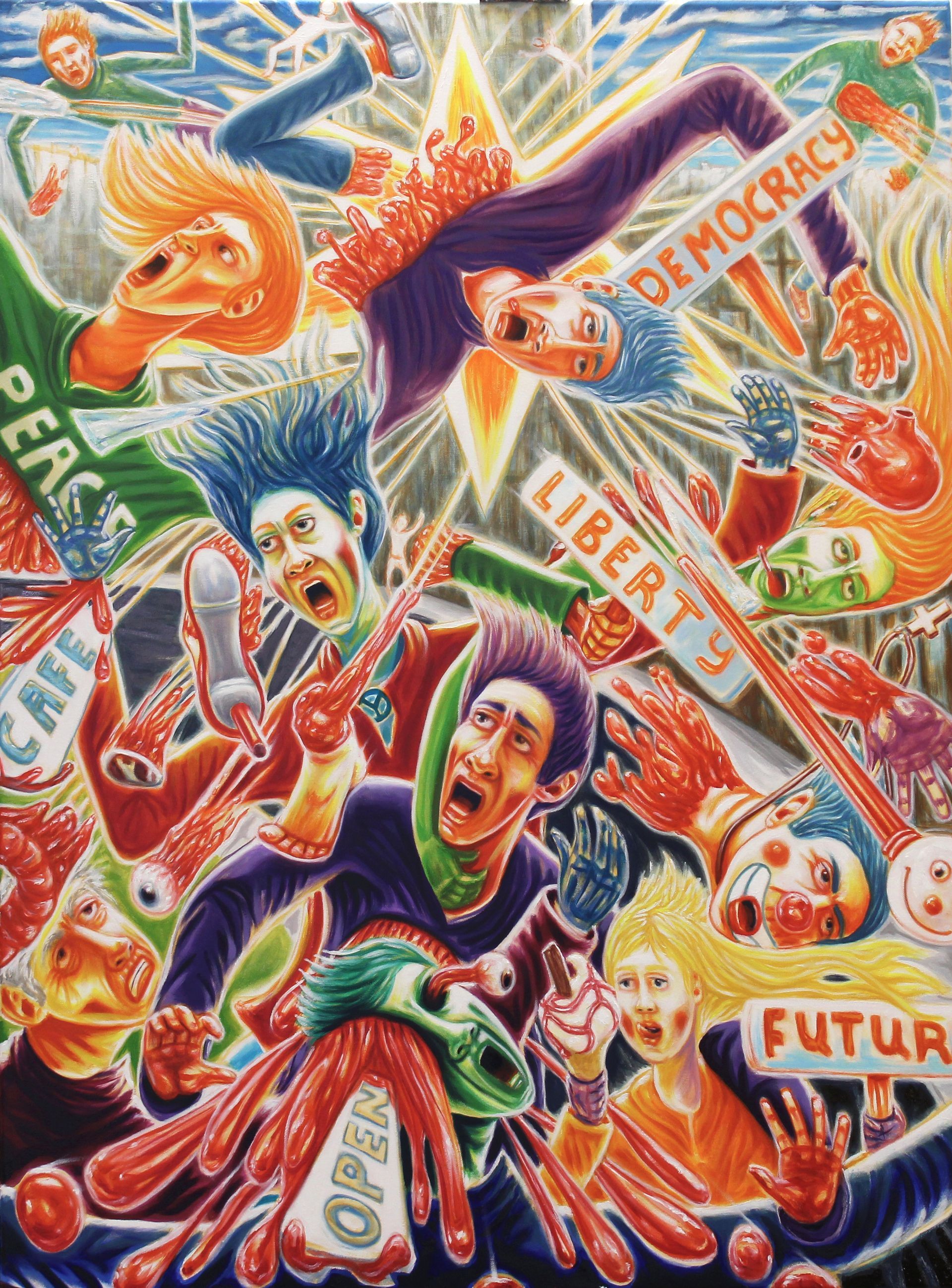
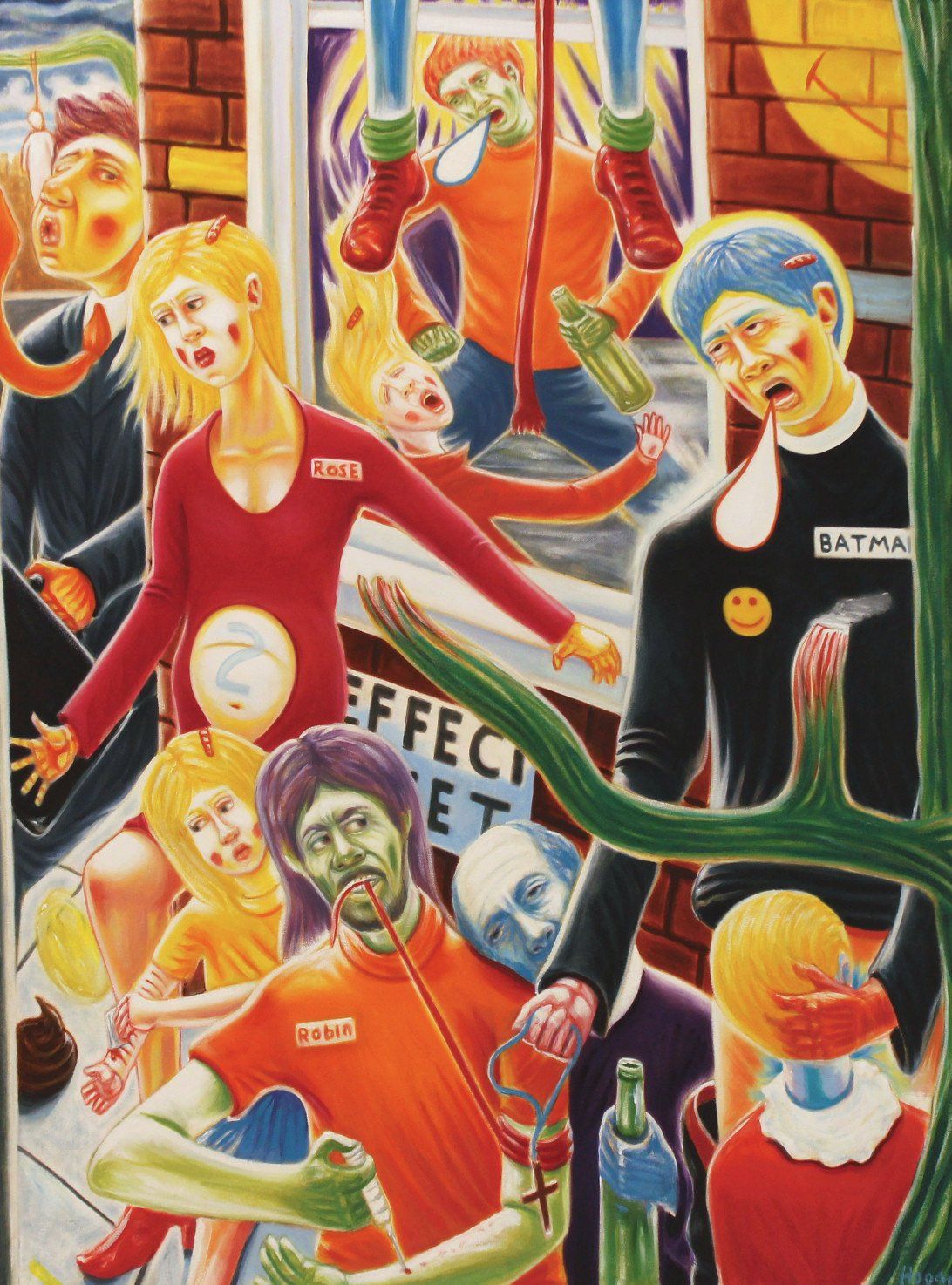
My art practice-based research project will re-conceive satirical painting within the turbulent and mediatised context of altermodernity through an autoethnographic studio process, resulting in a series of large format oil paintings and the production of a range of exhibitions that test displays of these works in a range of cultural settings. The research will therefore operate within three key contexts – histories of satire, the context and theory of altermodernism, and the development of an auto-ethnographic studio practice.
Satire
The historical theoretical discourse of satire is comprehensive, especially within the frameworks of literature, and theatre. Conden stipulates; “A putative origin within Greek satyr plays, that accompanied early tragedy then developed into Attic comedy, was questioned by Julius Caesar Scaliger (1484–1558) and seemingly disproved by Isaac Casaubon (1559–1614) who effectively supported the claim by the Roman rhetorician Quintilian (AD 35–c.100), that satire was a Roman invention (Casaubon 1605; Quintilian 1920–1922: 10.1.93). Casaubon argued that the word satire derived from the Latin, satura, medley or stew; and something of this etymology survived in English with “satira” being a broad platter (Bailey 1735; Facciolatus and Forcellinus 1828).6 Casaubon’s case has largely been accepted from John Dryden to the twentieth century” (Dryden1693; Highet 1962). (Conden, C. 2012) Satire has survived a multitude of theoretical incarnations. “Satiric theory, at least since the Renaissance, is seen as a series of attempts to deny elements that have long clung to satire and challenged its claims to morality and artistic unity-satyr (the half man-half beast, suggesting that satire is lawless, wild, and threatening) and lanx satura (the "mixed" or "full platter," suggesting that satire is a formless miscellany and food for thought) (Dustin, G. h. 1995) Contemporary Satire continues to offer a composite of elements, that continue to test assumptions of satires relevance. Satire as a field of scholarly theory and classification is constantly reinvigorated by contemporary events that test satire’s assumptions within a heterogeneous society. Bad news is seemingly everywhere, this is the milieu in which contemporary satire exists. Satire today has great viability and impetus within a society that is seemingly estranged from itself. Boland states, “The overall consequence of satire and critical discourse is the diffusion of generalised cynicism which takes the public sphere as a theatre of absurdity”. (Boland 2012) In times of high insecurity, anger at social inequalities, and the general public's disillusionment of the power elite, have enabled a revived focus on humour and satire, expressing public opinion, and appeasing anger and frustration. My project will draw contrast between the conventionally emphatic address of satire to a coherent wrong and address the cultural complexity of alter modernity as a vehicle of satire.
My research will denote satire from two perspectives, that of, social wrongs, perceived and accepted, and, satire as pluralistic entity. As Injustice and inequalities exist on an unforgiving scale, it is pertinent to evaluate social wrongs as pre curser to satirical entity. It is also acceptable to understand that satire exists within multitudinal paradigms, with few definitive delineations, only a diversification, describing pluralism, prevails. Declercq, offers a definition of satire, which necessarily sets out to critique and entertain, with the qualification that these purposes necessarily interact, a definition that improves our understanding of significance and outlines pathways to clarify its ambiguous reception. (Declercq, D. 2018) Humour, comedy, and laughter are a cathartic enterprise, a vehicle of entertainment. “There is nothing, it has been said, that intelligent humour cannot resolve in gales of laughter, not even the void... laughter, as one of humanity’s most sumptuous extravagances, even to the point of debauchery, stands at the top of the void” (Breton, A. cited in Higgie, J. 2007) Critique, a wholly individualised opinion, situation based, Satire exists as a need to criticise, to confirm one's self, and one's place within the world, to make sense of troublesome problems and apportion antagonistic views. “Satire helps us cope with a morally sick world, it helps us deal with the limits of critique through the solace of pleasurable autotelic engrossment in entertainment. Satire develops comic and ironic coping strategies that we adopt and adapt in the stories we tell about ourselves in a world that is sick beyond recovery” (Declercq, D. 2018) For the purpose of my research, I have devised two terms to describe the perceived levels of satire that may exist within paintings, that of, ‘silent’ satire and ‘voiced’ satire. ‘Silent’ describes an artist's inclusion of satirical codices, that may be subconsciously included, seemingly apparent, but unstated. Conversely, ‘voiced’ satire denotes an artist's use of satire, as main protagonist for codifying and describing. Building further upon Declercq’s Critique and entertainment, my research will postulate a development of satire within the nuanced representational painting genre. I will argue for a distinction of satire within painting’s narrative specificity, distinct from current satirical multimedia outlets.
Painting
“The practice of painting as a form of communication should be favoured on the basis of its tactility (Nonvirtuality). When experiencing painting, one is subscribing to a world that is less frenetic in the glut of information being consumed and a world where the construction of meaning is more deliberate”. (Robertson, J. McDaniel, C, 1999) How does Painting remain a relevant medium for the procurement of satire, when there are seemingly more proficient, contemporary mediums to proliferate satire's message? Durham, cites Otto Dix, a post-war German expressionist/satirist; Dix painted Images of sex workers, soldiers, and clueless bourgeois fat cats, and scenes of the aforementioned fraternising. Due to our immersive image culture, any capacity for this work to shock or unsettle us has now been eliminated. (Dunham, C. 2010) Contemporary Satire and its narrative remain quashed within the representational painting sphere, Elkins elaborates; “In the wake of the sea change from ‘narrative’ to ‘iconic’ works that is one of the hallmarks of early modernism, what has happened to the possibilities of narrative? after Picasso's rejection of narrative, certainly, the narrative has not been 'replaced' in any intelligible fashion by ‘iconic’ images, or by the pantheon of modernist ways of ‘writing’ in pictures”. (Elkins, J. 2012) however, my research will postulate a new rigour for narrative satire within painting. It is my belief that painting should be accessible, and unambiguous. Being easily read, I will argue that storied painting will enable a renewed cultural interest, and heightened engagement, comparable to contemporary multimedia.
The contemporary art world is characterised by pluralism. On one hand, signalling no dominance of any one, contemporary art style, On the other hand, pluralism is used to describe an attitude of anything goes, leaving qualitative concerns aside, in favour of tolerance, accepting everything, as equally valid. The narrative has been taken over by the video, while the importance of seeing and of being there, has been passed on to the realm of installation and performance art, where the actual space is an important component of the piece. The message, has been emptied from the painted piece and taken over by the critics, or the artists themselves, as a verbal activity, parallel and not necessarily related to the artworks being produced. (Fares, G. 2011) How then can representational painting, that is so indebted to, and informed by, a long and fruitful history, continue to remain a valid enterprise? Ken Currie a contemporary exponent of representational figurative painting, stated, in a recent interview that; Alex Katz (A prominent American figurative painter) has said, painting shouldn’t be mixed with other contemporary forms. Proclaiming that: “…painting ought to be shown separately from photography and video, in a contemplative space.” I would go further; Said Currie, ‘I don’t think Painting has anything to do with what we call “Contemporary art”. I think it’s an entirely separate art form now, with its own history, traditions and future.” (Thompson, P. 2021) Currie’s opinion Seemingly Disqualifying Rossalind Krauss’s, rhetoric; “The medium of painting is not just the canvas and paint, but the stretcher and the studio, the gallery, the museum, the collector and the dealer-critic system.” (Rossalind Krauss, cited in Costello, D. 2007). Paintings' effectual potential understands it as a language, from a semiotic perspective, as a sign system. There is a deep connection between the sign and its effective force. (Graw, I. 2018) If then a painting is fundamentally a unique set of signs and symbols, it may be assumed that there is an awareness of the codification of the sign's power. The artist is enabled to fashion an accumulation of these signs and symbols to proliferate a favourably strong message. Iconographic signs, such as Metaphor, subversion, parody, analogy and irony will be utilised, singularly and collectively, to apportion perceived reality indication, that fruitfully engages, and posits multi-narrative realisation modes. The narrative and the notion of authorship within painting has been, and continues to be, variably sanctioned. However, I will argue that Narrative, allegory is crucial to our sense of identity and moral deliberation. “The critical mode of the narrative allegory, creates a recognition of post-structural codes, the valorisation of textuality, irony, and the arbitrary in meaning theory, alongside the corresponding devaluation of expressive and formal elements in art, has created a renewed critical interest that has instigated a revised revaluation of allegorical practice so that the marked prejudice of allegory throughout history has been reversed.”(Slemen, S. 1998) I will utilise the power of my creative imagination to pictorialise mind images through the paint medium, images that elicit strong meaning, and aspire to engender, emotional procurement. In this instance, the themes for my practice will involve issues around, but not exhaustive of, inequality, inhumanity, the power elite, war, famine, societal critique, greed, disproportionate wealth, abuse, political oppression and economic exploitation, debauchery, sexual deviance, cruelty, hatred, and moral imperfection. We are living today in a time of crisis, a time of high confusion and low light. Dazed and confused, social satire helps us name and situate today's social phenomena, it lets us talk about the conditions in which we live. (Pym, W. 2018)
Painters may utilise satirical content to apportion strength of meaning to their creative dialogue. “Every artist whose work stems from relational aesthetics has a world of forms, a set of problems and a trajectory which are all their own. Their works involves social exchanges, interactivity with the viewer within the aesthetic experience being offered, and the various communication processes, serving to link individuals and groups together” (Bourriaud, N. 1998) Life, is affective, an individual painter's sensibilities may be infected by their environment and culture, along with the ‘wrongs’ of social inequalities, and injustices within it. “The disrespectful satire reminds us that art that opens up to the realities of life around it will spur an interest in the artist, resulting in personalisation of the work which then appears to be steeped in their persona and circumstances.” (Graw, I. 2018) An artist's Individual envirobiopsychosocialspiritual (Lawler) circumstance, is a precursor to unique autonomous authorship, and thus, is seated within the auspices of self-determination. Self-determination is closely related to creativity, within artists self-determination, remains a strong catalyst for personal, and creative change. A long tradition of empirical research has established that personal autonomy is a core characteristic of the creative personality (M.K, Sheldon 1995) Bourriaud’s Altermodernism further expounds on the notion of the self-determined, autonomous artist. In his vision, the artist becomes a Homo viator who travels and transpasses, drawing lines in space and time, materialising trajectories. (Bourriaud, N. 2009) Altermodern’s satirical relevance is founded upon what Bourriaud describes as nomadism (independent/self-determined) “Nomadism advances a critical strategy; its creative mobility challenges the homogenising aspects of capitalism”. (Bourriaud, N.1998) I will seek to validate Altermodernisms nomadism as transcultural universality, which offers an affordance of a broader spectrum for satire, as opposed to a politically secular one-culture view. “A strategic universalism, the artist as homo Viator, turns nomad, they transform ideas and signs, and transport them from one point to another”. (Bourriaud. N 2009) Universality, the quality of involving or being shared by all people or things in the world or of a particular group, is the paradigm in which my own practice exists. An example is a recent in-progress painting that centres upon a suicide bomber. A concept present within alternate cultures, and otherwise, unheard of within Uk culture.
Altermodernism
Nicholas Bourriaund who coined the term Altermodernism, curated The Tate Britain Tate Triennial in 2009. Altermodernism describes an insistent sensibility that has emerged in contemporary art in Britain in tandem with marked cultural and social change across the world. (Bourriaud, N. 2009) Conceptionally, Altermodernism moves beyond the paradigms of post modernism, “Despite valiant recent attempts to move "the postmodern critique forward" (Allan), to generalise it into a "theory of the contemporary" (Connor), or to pluralise it into the more descriptive postmodernisms (Altieri), the postmodern does indeed appear to be a twentieth-century phenomenon, that is, a thing of the past”. (Hutcheon, L. 2002) Altermodernism moves into a new epoch in which a narrative within representational satirical painting can belong. This personal wavelength conveys in its emanations, signs that are both heterogeneous (belonging to differing registers or cultural traditions) and heterochronic (borrowed from differed periods) (Bourriaud, N. 2009) The Tate biennial exhibition was curated to involve the artists that Bourriaud recognised as fulfilling the new Altermodern agenda. “The art is characterised by artists cross border, cross cultural negotiation; a new real and virtual mobility: the surfing of different disciplines, and the use of fiction as an expression of autonomy.”(Enwezor, O. 2008) A number of the artists that exhibited, fulfilled a representational painting perspective. Notably, Navin Rawanchaikul, a Thai artist whose ancestral roots are the Hindu-Punjabi communities of present-day Pakistan. Bourriaud wrote in a ‘letter to the editor', in Navin's Sala 2008; “This generosity of iconography: Perhaps we have got too used to a dry spell of thought, instead of highlighting this tradition as such, like those bad artists who have no other ambition than to conform to what the market demands of them.” (Bourriaud, N. 2009) By including Rawanchaikul’s work within the Altermodern exhibition, Bourriaud validates representational painting within contemporary art practice. Bourrriaud states; Artwork as social interstice; A relational art, an art taking as its theoretical horizon, the realm of human interactions and its social context, rather than the assertion of an independent and private symbolic space, that points to a radical upheaval of the aesthetic, cultural and political goals introduced by modern art. (Bourriaud, N. 1998) A contemporary artist that operates within the satirical field is Ken Currie who approaches satire from a portrait/representational painter perspective. His work is often dark and melancholy, it is particularly interested in aspects of social commentary, focusing on the dehumanising effects of society and cultural inequalities through ‘silent’ satirical codification. Currie attests; Commenting on our current predicament is part of what I want to say, and I do think that painting can address these issues if it’s done subtly and allusively. (Thomson. P. 2021) Although Curries' work utilises the subtly of metaphor, his work, is often strongly metaphorically codified, utilising human blood/fluids, gore, and the macabre, to offer strength of purpose. Currie has stated; Political anxieties about what’s going on in the world filter through, class struggle and class identity, are always in the back of my mind. The lust for the spectacle of violence is deep and has immemorial roots in the human species. (Thomson. P. 2021) Neo Rauch, is a German figurative painter working within, I would argue, the ‘silent’ satirical field. Rauch who cites Otto Dix as an influence, utilises a large array of iconographies such as analogy, metaphor, parody and subversion, to codify representation, and to fortify his message. His subject matter is often Subverted (iconography borrowed from other periods of time and re-established within a contemporary configuration) figures skewed, resized and elongated, picture plane and perspective, distorted, and, dissolved. All the elements visually harmonising and read as, satirical social commentary. Rauch, in a recent interview, stated; “In my darkest moments, I feel like I might understand the world I live in. This means that its acting mechanisms come to light in an uncensored, open fashion. The absurd, the nonsensical, the mixture of sensations such as fear, the search for safety, melancholy, solitude” (Cué, E. 2016) To apportion the converse of representational painting, my research will reference the American artist, Paul Macarthy. Macarthy Is a ‘voiced’ satirist, in the extreme. He utilises the codices of satirical social commentary within video performance art. Macarthy utilises strong metaphors in his work, often pushing the limits of acceptance, and social taboo. Robert Storr critic was interviewed by Heni Talks 2019. In the interview Storr defended the gut-wrenching work of Macarthy stating; If you think about the British satirical tradition, Gilray, and the illustration artists of the 19th century, you will find, for example, Napolean swimming in a river of turds. If people can handle Gilray, why can't they handle Macarthy (Storr, R. 2019) Life, can be seen as affective, an individual artist's sensibility may be infected by their environment and culture, the ‘wrongs’ of social inequalities and the injustices within, and permeated through an artist's Individual Somology (envirobiopsychosocialspiritual) Lawler states; “understanding the body as an integration of the object body into an experience so that it is simultaneously an object, a means of experience, a means of expression, a manner of presence among other people, and a part of one's personal identity” (Lawler 2006) Circumstance, is a precursor to individual authorship, and seated within the auspices of self-determination. Self-determination is closely related to creativity, within artists self-determination, remains a strong catalyst for personal, and creative change. “The autonomy-creativity relation measures personal autonomy derived from self-determination. A long tradition of empirical research has established that personal autonomy is a core characteristic of the creative personality”. (M.K, Sheldon 1995) An autonomous self-determined author uses self-reflection, writing and art, to explore anecdotal and personal experience. I will seek to apportion my practice within the auspices of autoethnography, drawing upon my own lived experience, as a vehicle for ascertaining a voice for practice. Auto ethnographers believe that personal experience is infused with political/cultural norms and expectations, they engage in rigorous self-reflection referred to as “reflexivity” in order to identify and interrogate the intersections between the self and social life. Fundamentally, auto ethnographers aim to show “People in the process of figuring out what to do, how to live, and the meaning of their struggles” (Bochner & Ellis, 2006) Autoethnography is essential for practice-based research because it values personal insights and enables the intimacy required to uncover valuable tacit knowledge. Using vignettes from life experiences, and symbolic interaction, autoethnography and other representations of self can be conveyed in a layered process. Autoethnography includes the recognition of the ways personal/cultural identities, shape perception, and experience, the importance of narrative storytelling, and the crisis of representation, autoethnographic projects use selfhood, subjectivity, and personal experience to describe, interpret and represent beliefs (Adams,T.E. Herrmann, A.F. 2020) Martin Kippenberger, is a proponent of autoethnographic methodology. Inspiration for artists often stems from personal experiences, and it was no different for Kippenberger. For example, He spent a great part of his life on the island of Syros, so it is no wonder that his first footprint of the ‘Metro-Net' (1993), was to be planted there. (Monat Shefte, K.H. 2007) Kippenberger also understood that the necessary process of engagement between artist and viewer could be utilised for profit. Williams states; Kippenberger was well aware of the anecdotes draw for both artist and audience: it gives the impression of dialogue and shared ideas, appearing to produce a bond, however tenuous, between producer and recipient. (Williams, G. 2006) The integration of practice-based research will aid in the production of an evidence base for research findings. A body of oil paintings will be created, the satirical paintings will enable a confluence between image and observer, and will facilitate discourse, which can then be quantified and evidenced.
Methodology
My research is studio and exhibition based. My paintings as case study will be a frame of reference for theory and practice assimilation, and presented to selected groups, as evidence. These private and public contexts of practice are the testing grounds for my research. Audience participation will be encouraged through questionnaires and arranged interviews. Positioned as facilitator (exhibition) the satirical paintings will act as a catalyst, for individual and public debate. If successful, the work will sensitively engage, and gainfully procure emotional responses.
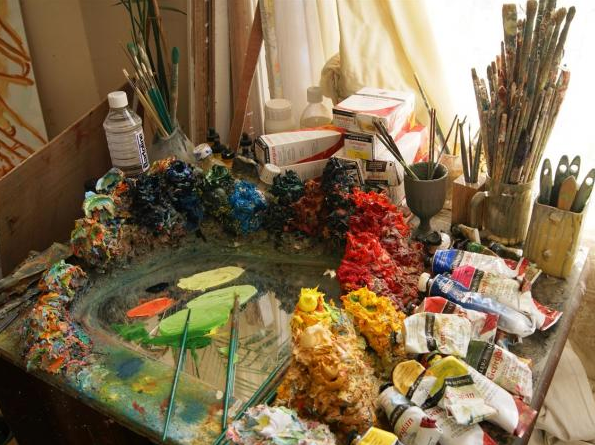
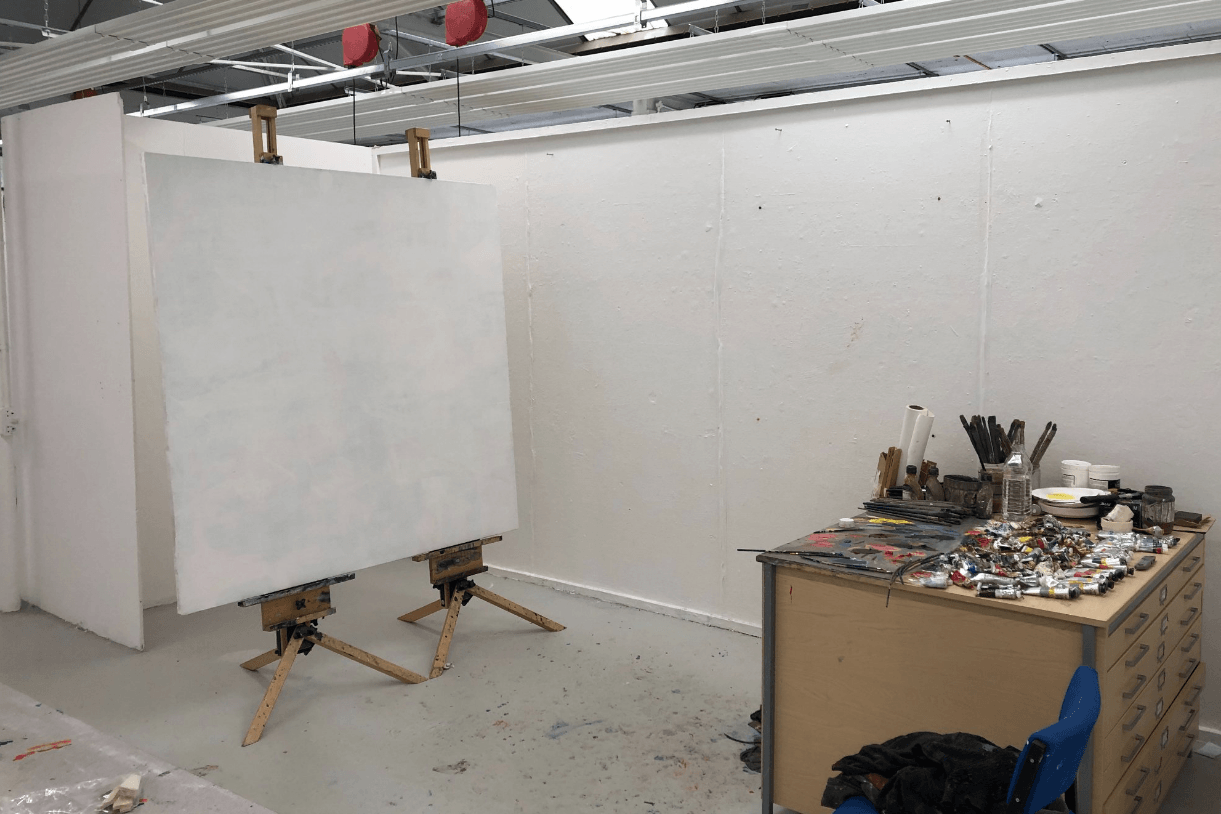
The Studio is the context of auto-ethnographic painting where I will develop works that contextualise personal experiences and frame them at the junctures of social relations. This will be both thematic and structural, how I make a painting and arrange the components within it. It is also a space where I will test issues of format, scale and hang. As homo viator /nomadic practioner I will develop a pictorial language informed by learned experience, and the codices of satire to support my research. I will seek to measure the most significant moments in personal lived experience. As homo Viator, my critical analysis will enrich my process, the progress will inform my thesis, through satire, alter modernity, and auto-ethnography. The wider relational constitution of painting practice will also be a focus. My painting practice and the production of a body of large-scale paintings will offer a vehicle for affordance of meaning, satirical codification creates a structured method representing a unique homo viator experience. My plan is to also create a dialogue of my thought processes within a live experiential video sequence. (Recording paintings process through interpretation) I will record myself engaged in my practice, from a blank canvas beginning, the process will inform and support my studio practice by analysing my process. I will explain my vision, as I progress through the painting's development, and facilitate a discursive argument for the validity of my vision. Emergent ideas in the work, clashes and conflicts as positive values and visual cues/codices such as deviance, metaphor, parody and subversion will be analysed.
To facilitate exhibition plans and testing points for the practice embedded within fixed feedback points in the process. It is my intention to organise and curate several exhibitions of my work. I will contact Clare Gannaway curator, contemporary art, Manchester Art Gallery, to attain advice and guidance regarding the planned Holden Gallery (Manchester) exhibition. Another planned exhibition is Preston bus station where there may be high footfall of an untrained and unbiased audience. Conversely, Holden gallery, Hammond gallery, and P1 gallery are within each university's remits with a high contingent of biased Academic peers, thus, collectively, offering a broad spectrum of societal interaction. I will ask for audience participation by supplying questionnaires, and participatory dialogue, to quantify message orientation, and effectiveness, and to ascertain positive and negative effects.
A further selection of work from my research practice will be photographed and formatted for cross-digital orientation. The work will be used to augment a collection of data via surveys and questionnaires, from both social media and direct mail. I will venture out of my niche and field to find comparative analysis and arguments. Materials to be collected through fieldwork Museum/Painting visits and recording of data (audio and visual) and exploration will be analysed.
I will organise a field study to attend the museum of Modern Art in Liverpool to view a Ken Currie painting within the museum's collection. The visits to view Ken Currie's paintings will inform the process of my practice by example and through the application of ideas and style. I will study the live painting and record visual, written and audio observations. I will also attend the Manchester Museum of Modern Art. I will locate Contemporary art that I consider contains satirical elements, the works and their satirical content will then be discussed with members of the public utilising Audio recordings/interviews.
My intention is to test the work publicly in the Hanover Project, Preston Bus Station, and the Holden gallery (Manchester Metropolitan University) this will allow me to test how the work functions contextually and how it informs the contexts in which it is situated. The work will engage audiences in a manner that is productive relationally and discursively. One-to-one interviews will be undertaken to understand individual opinions and objections. The critical analysis gained will enrich the project process and the process will inform my thesis. My practice will be formulated under the auspices of autoethnography. Autoethnography as reflective and discursive process. Autoethnographic evidence gathering will be utilised through personal participant observation techniques: Text, audio, video, user experience and reflection. The format of painting and drawing offers auto ethnographers the possibility of analysis and evocation. Self and society exist ‘sous rature’ and in difference from each other, thus making autoethnographic artwork a useful tool for symbolic interaction. (Rambo, C. 2017)
An ongoing literature review will contextualise my practice. The completed socially engaged practice-based project will be supported by a 40,000-word thesis.
Originality
By presenting Satirical painting as alterity through specificity and focusing within the changing cultural framework of Alter modernity, I argue for a refined and nuanced discussion of the utilisation of satirical commentary within the representational painting genre, as affectual conscientious descriptor, and provocateur, above and beyond present contemporary multimedia, and modern art’s theoretical ideation. My research and practice evidence are both a protest of the historicises of modern and postmodern art ideology (anti-satirical, anti-narrative) and, to act as catalyst for engrossment within personal and societal understanding of satirical engagement and proliferation. My research project brings a new synthesis of these established modes within a practice-based project.